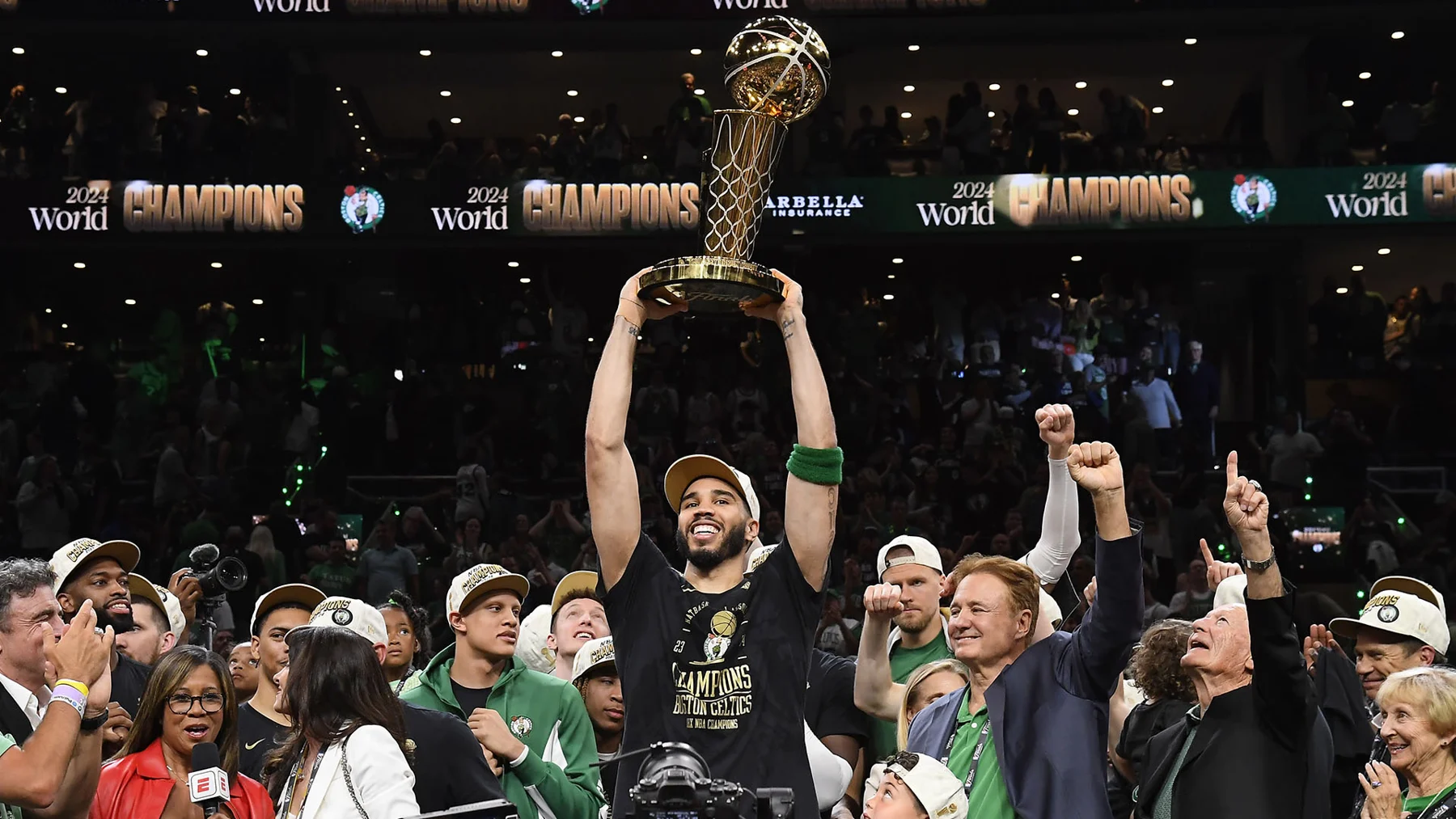
Boston finished the 2023–24 NBA regular season at 64–18, while Oklahoma City and Denver shared the West's best record at 57–25. The standings closed on April 14, 2024. They established the postseason starting positions, but the Play-In still had to determine the seventh and eighth playoff seeds.
The tables below preserve that distinction. They show all 30 teams' final regular-season records and conference ranks alongside the playoff seeds actually earned. The analysis then explains the season's consequential ties, the Play-In changes and how the April picture relates to Boston's eventual championship.
Final 2023–24 NBA standings for all 30 teams
“Regular rank” means the team's position in its conference after the 82-game regular season, with the applicable ties resolved. “Playoff seed” means its position in the eight-team playoff field after the Play-In. A dash indicates that the team did not reach the first round. Play-In and playoff results are not added to the W–L record.
This is a historical table for the season ending in 2024, rather than a current NBA ranking. Its records can be checked against the Pacers' 2024 playoff guide and the Thunder's subsequent media guide. Those archives also preserve the head-to-head results needed to understand tied records.
Eastern Conference final records
Boston was the East's only team above 50 wins. The next six teams occupied a narrow range from New York's 50 to the three clubs at 47. That compression made the line between a direct playoff berth and the Play-In especially consequential. Miami, at 46 wins, sat only one victory below the three-team cluster but still needed to earn a first-round place.
| Regular rank | Team | W | L | Playoff seed |
|---|---|---|---|---|
| 1 | Boston Celtics | 64 | 18 | 1 |
| 2 | New York Knicks | 50 | 32 | 2 |
| 3 | Milwaukee Bucks | 49 | 33 | 3 |
| 4 | Cleveland Cavaliers | 48 | 34 | 4 |
| 5 | Orlando Magic | 47 | 35 | 5 |
| 6 | Indiana Pacers | 47 | 35 | 6 |
| 7 | Philadelphia 76ers | 47 | 35 | 7 |
| 8 | Miami Heat | 46 | 36 | 8 |
| 9 | Chicago Bulls | 39 | 43 | — |
| 10 | Atlanta Hawks | 36 | 46 | — |
| 11 | Brooklyn Nets | 32 | 50 | — |
| 12 | Toronto Raptors | 25 | 57 | — |
| 13 | Charlotte Hornets | 21 | 61 | — |
| 14 | Washington Wizards | 15 | 67 | — |
| 15 | Detroit Pistons | 14 | 68 | — |
Western Conference final records
The West had a different shape: three teams reached at least 56 wins, followed by a dense group from the Clippers through Golden State. Houston's 41–41 record was sufficient for a .500 season but left the Rockets five wins behind the final Play-In place. The Lakers and Pelicans show the main reason to retain two position columns: their regular-season order was reversed in the playoff field.
| Regular rank | Team | W | L | Playoff seed |
|---|---|---|---|---|
| 1 | Oklahoma City Thunder | 57 | 25 | 1 |
| 2 | Denver Nuggets | 57 | 25 | 2 |
| 3 | Minnesota Timberwolves | 56 | 26 | 3 |
| 4 | LA Clippers | 51 | 31 | 4 |
| 5 | Dallas Mavericks | 50 | 32 | 5 |
| 6 | Phoenix Suns | 49 | 33 | 6 |
| 7 | New Orleans Pelicans | 49 | 33 | 8 |
| 8 | Los Angeles Lakers | 47 | 35 | 7 |
| 9 | Sacramento Kings | 46 | 36 | — |
| 10 | Golden State Warriors | 46 | 36 | — |
| 11 | Houston Rockets | 41 | 41 | — |
| 12 | Utah Jazz | 31 | 51 | — |
| 13 | Memphis Grizzlies | 27 | 55 | — |
| 14 | San Antonio Spurs | 22 | 60 | — |
| 15 | Portland Trail Blazers | 21 | 61 | — |
For comparisons across archives, use the full season label and the same stage of competition. A table of division standings can display teams in a different order from a conference table, and a playoff bracket can relabel a Play-In participant without changing its regular-season finish. Those are different views of the same season, not conflicting records.
Boston's 64 wins created a separate Eastern race
The defining feature of the East was separation at the top. Boston's 64 wins put it 14 ahead of New York and seven ahead of either Western leader. Its .780 winning percentage describes a substantially stronger full-season record than the cluster battling beneath it. The race for second was close; the race for first had a different scale.
The Celtics' 2024 game notes show a 37–4 home record and 27–14 on the road. The home figure helps explain why earning the right to begin and potentially finish series at TD Garden mattered. The road record also prevents an overly narrow reading: Boston did not build 64 wins solely by protecting its own floor.
For a fan reading the final table, that gap is stronger evidence of sustained regular-season performance than a last-ten-games streak. A late run can reflect changing opponents, availability and incentives after positions are settled. Boston's record encompasses the entire schedule. It should be the starting point for describing the season, rather than being replaced by the final result of one April matchup.
It still does not establish that every opponent was favorable. Boston lost both regular-season meetings with Denver: 102–100 at home in January and 115–109 on the road in March. Those games did not erase the Celtics' better overall record, just as the overall record did not erase Denver's success in that particular pairing. Full-season strength and head-to-head evidence answer related but different questions.
That distinction keeps historical comparisons useful. The standings support calling Boston the regular season's clearest leader. They do not prove that a championship was inevitable or that every future series would follow the same pattern. The Celtics still had to solve individual matchups and win four playoff rounds. The eventual title validated the season's broad direction, but the 64–18 record was already meaningful evidence before any postseason game began.
The Western ties that changed the bracket
Three Western ties had three different consequences: the top seed, the last direct playoff berth and the location of an elimination game. Reading the tied records without their resolved positions misses much of the final table's practical meaning. A tie can leave the number in the wins column unchanged while changing the entire next step.
Oklahoma City finished ahead of Denver at 57–25
The Thunder and Nuggets finished level, but Oklahoma City won their regular-season series 3–1 and took first place. Minnesota finished one game behind at 56–26. The distinction matters because the three teams entered the final day tied; they did not finish the season in a three-way tie. A scenario published before Game 82 is not the completed standings.
Oklahoma City's position put it on the first-versus-eighth side of the bracket, while Denver entered the second-versus-seventh matchup. The Thunder had earned the right to open Western series at home, including a potential conference final against Denver. That was a conditional advantage, not a prediction that both teams would reach that round.
The result also illustrates why a later draft-order tiebreak must not be substituted for postseason seeding. Teams tied in wins can be treated differently for separate league purposes. For this table, the relevant evidence is the regular-season head-to-head record and the published playoff order.
Phoenix and Sacramento won consequential ties
Phoenix and New Orleans each finished 49–33. The Suns' 2–1 season-series advantage put them sixth and left the Pelicans seventh. Sixth meant a first-round berth without a Play-In game; seventh meant hosting the Lakers with a playoff place still to be earned. This was a far greater practical difference than two adjacent rows might suggest.
Sacramento and Golden State both finished 46–36 and split their meetings 2–2. The Kings' better division record put them ninth and the Warriors tenth, giving Sacramento the home floor for their elimination meeting. Neither team gained the two-chance route available to seventh and eighth. The reward here was venue, rather than an additional margin for error.
These cases explain why “tied” does not mean “interchangeable.” Oklahoma City and Denver were competing over the top of the bracket, Phoenix and New Orleans over direct entry, and Sacramento and Golden State over home court in one high-pressure game. For the general procedure behind such decisions, the standings and tiebreaker guide provides the broader rules.
Orlando, Indiana and Philadelphia all finished 47–35
The East's most instructive tie involved three teams rather than two. Orlando, Indiana and Philadelphia each won 47 games, yet occupied fifth, sixth and seventh. The different outcomes were produced by the procedure for that tied group. Simply comparing whichever pair interests you can lead to the wrong answer.
Orlando's Southeast Division title mattered in the three-team tie. Once the Magic received the higher position, the remaining Indiana–Philadelphia tie was resolved separately. The Pacers had won that season series 2–1 and therefore finished sixth, with Philadelphia seventh. This is why a multi-team tie cannot always be understood by sorting a single column of head-to-head wins.
The counterintuitive detail is that Philadelphia swept Orlando 3–0. That did not put the Sixers ahead of the Magic in the final three-team scenario. It would be inaccurate to explain the final order by saying Orlando simply beat both tied teams head-to-head. The division-winner criterion and the reconsideration of the remaining tie are the essential steps.
One record produced three different routes
Orlando's fifth place created a first-round series against fourth-place Cleveland. Indiana's sixth place sent it to Milwaukee. Both could prepare for a best-of-seven matchup as soon as the regular season ended. Philadelphia instead had to host Miami in the seventh-versus-eighth Play-In game before it could know its first-round opponent.
The Pacers removed uncertainty with a 157–115 win over Atlanta on the final day, securing their direct berth. The result is a reminder that a seemingly ordinary regular-season finale can control the preparation window, the opponent and the number of elimination risks facing a team. The season's 47 wins were identical; the positions those wins earned were not.
None of this is a claim that a fifth-place team must be better than a seventh-place team in every possible series. The standings answer a rules-based qualification question using completed results. A matchup assessment can also consider availability, rotation changes and specific strengths. Historical analysis is clearer when it preserves the exact qualification result before discussing those additional judgments.
How the 2024 Play-In changed the final playoff seeds
The final regular-season table established the Play-In matchups, rather than completing the playoff field. Seventh hosted eighth for one immediate berth. Ninth hosted tenth in an elimination game, with its winner facing the seventh-versus-eighth loser for the remaining place. The higher pair therefore had two opportunities to qualify; the lower pair needed two wins.
Philadelphia and Miami completed the East field
Philadelphia beat Miami 105–104 on April 17 to earn the seventh playoff seed and a first-round series against New York. Miami then beat Chicago 112–91 on April 19 to secure eighth and face Boston. Chicago had eliminated Atlanta before losing to the Heat. Neither the Bulls nor Hawks reached the eight-team playoff bracket.
The East's eventual seventh and eighth matched its regular-season order, but that was an outcome, not an automatic promotion. Philadelphia needed to win the first game, and Miami had to recover from losing it. A historical table that merely lists four Play-In qualifiers without the actual results leaves this qualification step unfinished.
The Lakers moved to seventh and New Orleans to eighth
The West produced a visible reorder. The Lakers, eighth in the regular standings at 47–35, won 110–106 at New Orleans on April 16. That earned Los Angeles the seventh playoff seed and a matchup with Denver. New Orleans, seventh at 49–33, then beat Sacramento 105–98 on April 19 and entered the playoffs as eighth against Oklahoma City.
Sacramento had first eliminated Golden State, using the home game its ninth-place finish provided. The subsequent loss to New Orleans ended the Kings' season. Their ninth place remained a regular-season finish, not an invented ninth playoff seed. Golden State likewise did not become a tenth seed in an eight-team bracket.
These results explain two numbers that can look contradictory in an archive: New Orleans can be “seventh” in the standings and “eighth” in the playoffs, while the Lakers can be the reverse. Both descriptions are correct when labeled. The Pelicans' Play-In loss and win do not change their 49–33 regular-season record, and the Lakers' qualifying win does not turn 47–35 into the record displayed in the final regular table.
What the standings meant for home-court advantage
A better position changes where a series can be decided. The 2024 playoffs used a best-of-seven, 2–2–1–1–1 arrangement: the team holding home-court advantage hosted Games 1 and 2, then Games 5 and 7 if needed. Its opponent hosted Games 3 and 4, and Game 6 if necessary. Those final three games were possibilities, not guaranteed dates.
Boston, New York, Milwaukee and Cleveland opened the East's first-round series at home. Oklahoma City, Denver, Minnesota and the Clippers did so in the West. This gave the top four a tangible scheduling benefit, even when the records were close. Cleveland's 48 wins, for example, put its potential seventh game against 47-win Orlando on the Cavaliers' floor.
The regular-season record also matters when comparing the two conference champions. Boston's first seed and Dallas' fifth seed describe their respective conference positions; the Finals' home-court decision did not simply compare those labels. The Celtics' 64–18 record was better than the Mavericks' 50–32, and the Finals began in Boston. The title was ultimately clinched at TD Garden in Game 5.
For a traveling fan, the distinction between an earned hosting right and an actual fixture is essential. A team can hold the right to host Game 7 yet finish the series in five. A favorable seed therefore creates an opportunity, rather than guaranteeing a particular home game. The standings establish the order; series results establish which conditional games become necessary.
Home court also does not make a series win automatic. It gives a team the first two games at home and the deciding venue if the series goes the distance. The opponent can still win on the road or close the series before Game 7. Treat the venue advantage as one consequence of the season's results, alongside the opponent and preparation time, rather than converting it into a certainty about who advances.
What the final table explains about the 2024 playoffs
Boston finished the job its regular season suggested it could do. The Celtics won the championship with a 16–3 postseason record, beating Dallas in five games. Their 106–88 Game 5 win on June 17 closed the season at TD Garden, with Jayson Tatum recording 31 points, 11 assists and eight rebounds. Jaylen Brown was named Finals MVP.
The West provided the useful counterexample to treating the standings as a forecast. Fifth-place Dallas eliminated the Clippers 4–2, Oklahoma City 4–2 and Minnesota 4–1 to win the conference. Every one of those opponents had more regular-season wins than the Mavericks. Dallas' 50–32 record accurately described its season; it did not prevent the team from winning three series that began on the road.
Indiana also traveled beyond what a casual reading of “sixth” might imply. The Pacers reached the Eastern Conference finals before Boston swept that series. A lower seed can survive successive matchups without the original table becoming wrong. The standings determine entry positions and hosting rights; they do not award the next round in advance.
These outcomes leave two conclusions worth holding together. Boston's large regular-season advantage was substantial evidence and preceded a convincing championship run. Dallas' conference title shows that the same evidence is incomplete when the question changes to a specific seven-game matchup. Availability, rotation choices and performance against one opponent all matter within that narrower contest.
For historical comparisons, retain each stage's own record. Boston's regular season remains 64–18; its playoffs were 16–3. Adding them produces an 80–21 combined season, but that combined figure does not belong in the regular standings column. Similarly, Dallas' Finals appearance does not move it to first in the April Western table.
The clearest reading of 2023–24 therefore keeps three layers visible: the complete 82-game records, the qualification and seeding decisions, and the series that followed. Boston led the first layer and won the last. Oklahoma City won the West's seeding tie; Dallas won the West's playoff bracket. Those are distinct achievements, and preserving their differences makes the season easier to understand.
Sign in with Google to join the discussion.