The best NBA plays of all time become more interesting when you restore the game around the highlight. A shot can end a season, a steal can rescue a possession and a spectacular finish can outlive the result. These ten selections show different forms of basketball excellence, with the dates, opponents and stakes kept attached.
This is an editorial selection, grouped by what the play accomplished, rather than an official all-time ranking. It favors possessions that reward another look at the setup and the next action. Official NBA footage is linked for each moment; availability can vary by location and account.
Four shots that ended a game or a title pursuit
A game-winning shot and a buzzer-beater are different descriptions. The first changes who wins; the second describes its timing. Three selections here ended a playoff game at the horn. The other left the opponent a final opportunity, yet ultimately helped decide a championship. Keeping the clock in view makes the stakes clearer than a montage of celebrations.
Michael Jordan's 1989 shot over Craig Ehlo
On May 7, 1989, Chicago beat Cleveland 101–100 in Game 5 of their first-round series. Jordan's jumper over Craig Ehlo ended a best-of-five contest 3–2. The NBA's official video of The Shot captures the release and the immediate celebration, while its historical account restores the preceding possession.
Ehlo had just put Cleveland ahead 100–99 with three seconds remaining. That detail matters: he was an active contributor to a potential series win, rather than simply the defender frozen in an unfavorable image. Chicago needed a catch and a controlled release under immediate pressure. Watch Jordan create enough separation to get airborne, then keep his shooting action composed as Ehlo contests.
The resulting fist pump is memorable because elimination had been so close. The basket did not win a championship; it preserved the Bulls' postseason and supplied a defining early example of Jordan deciding a series. Start the replay before the inbound to see a very short possession contain several separate tasks.
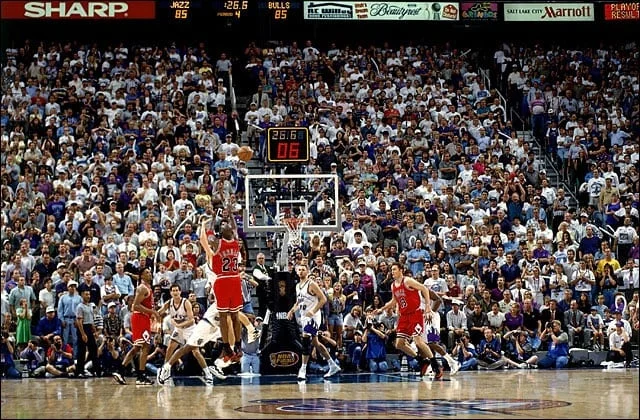
Jordan's last Chicago basket in the 1998 Finals
On June 14, 1998, the Bulls beat Utah 87–86 in Finals Game 6 and won the series 4–2. Jordan's jumper left 5.2 seconds. It was his final basket for Chicago, rather than his final NBA basket, and it was not a buzzer-beater. The NBA's steal-and-jumper replay is the useful version to watch.
The preceding steal from Karl Malone explains how the Bulls regained control. Reducing the sequence to Jordan facing Bryon Russell removes the defensive action that made that possession available. After the jumper, Utah still had a chance to respond, so the final score supplies information that the celebrated follow-through alone cannot.
Watch how the dribble threatens forward movement before Jordan creates room for the pull-up. The enduring image combines individual balance with a team situation demanding a score and a stop. It is a title-clinching sequence whose full meaning takes more than the final shot to explain.
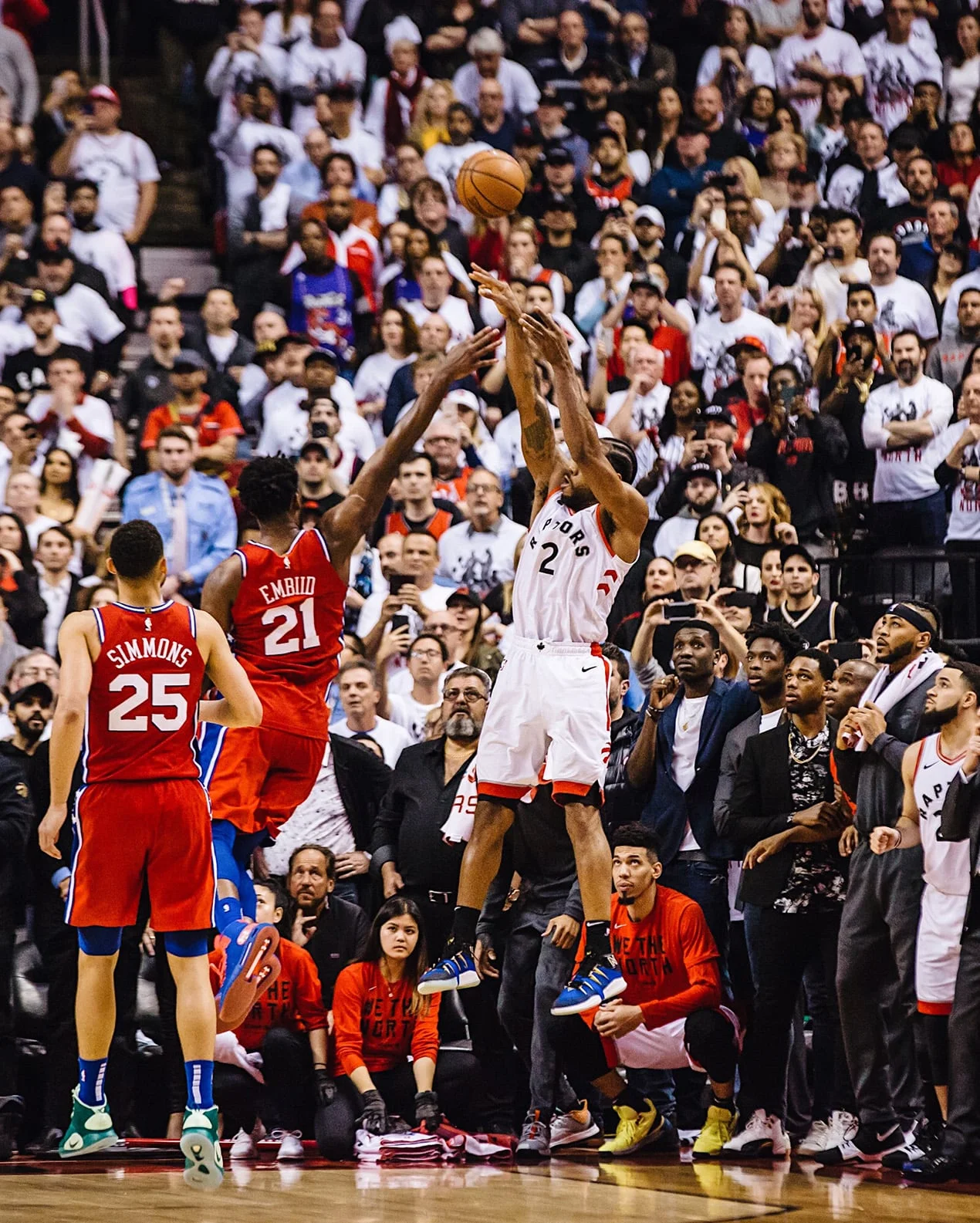
Kawhi Leonard's four-bounce winner in 2019
Toronto and Philadelphia were tied 90–90 late in Game 7 of the Eastern Conference semifinals on May 12, 2019. Leonard's corner fadeaway went over Joel Embiid, struck the rim four times and fell through for a 92–90 Raptors win. The NBA's extended ending preserves the long pause between the release and the result.
The difficulty begins before the ball reaches the rim. Leonard has to move toward the right corner and release over a much taller contest before time expires. The arc gives the attempt a chance to clear that challenge. The bounces add uncertainty after the player has finished every action he can control.
It is tempting to describe the shot as a championship winner because Toronto later won the title. Its immediate achievement was different: advancing to the conference finals. That precision makes the moment stronger, because an entire Game 7 was balanced on the final bounce without requiring an inflated description of the round.
Damian Lillard's long-range goodbye to Oklahoma City
On April 23, 2019, Portland beat Oklahoma City 118–115 in first-round Game 5, closing the series 4–1. Lillard's 37-foot three over Paul George brought his total to 50 points. The NBA's game performance video puts the final attempt inside the scoring night that preceded it.
The shot is remarkable partly because the distance makes normal defensive assumptions uncomfortable. George must respect a drive while facing a shooter prepared to pull up far outside conventional range. That does not make every similarly distant attempt a wise choice. Lillard's skill, the tied score and the clock created a particular decision, rather than a universal instruction to shoot from the logo.
Watch his patience before the stepback and the separation at release. The wave afterward belongs to the story because the series ended immediately. Keep this play distinct from his 2014 winner against Houston: the opponent, distance and game situation were different, even though both became defining Portland memories.
Three defensive plays that preserved a chance to win
Defense can produce a winning moment without adding a point. These possessions begin with Boston leading, Boston trailing and Cleveland tied. Their different score states explain what success means: deny one final attempt, create an immediate scoring chance or prevent an opponent from taking the lead. Watch the players away from the ball as closely as the player credited with the stop.
John Havlicek interrupts Philadelphia's last possession
Boston led Philadelphia 110–109 with five seconds left on April 15, 1965, in Game 7 of the Eastern Division finals. Havlicek disrupted Hal Greer's inbound pass, and the Celtics preserved that final score to advance. The NBA's official Havlicek footage shows why an inbound is itself a competitive possession.
The passer has a limited window, the receiver needs a safe angle and the defender can study both without committing too early. Havlicek's timing attacks the passing lane at the moment Philadelphia must deliver the ball. Sam Jones then helps secure the outcome by controlling the loose ball. The stop is remembered under one name, but possession still has to be completed after the first touch.
Unlike a spectacular block after a shot has already gone up, this play removes the shot from the sequence. That is its defensive achievement. The famous broadcast call amplifies a basketball fact: Boston's one-point margin survives because Philadelphia's last planned opportunity never becomes a clean scoring attempt.
Larry Bird turns an inbound pass into Dennis Johnson's layup
On May 26, 1987, Boston beat Detroit 108–107 in Game 5 of the Eastern Conference finals. Bird intercepted Isiah Thomas' inbound pass intended for Bill Laimbeer and found Dennis Johnson cutting to finish. The NBA's steal-and-assist replay keeps the two parts together.
Bird must first reach the ball and remain inbounds. Johnson must recognize the new situation and move toward the basket while Detroit is still reacting to the turnover. A steal without that cut could leave Boston scrambling for a rushed attempt. The finish converts anticipation into the lead, with only a second left.
The series moved to 3–2 for Boston; the play did not end the entire matchup that night. Its value was to reverse a late losing position and change the next game's stakes. Compare it with Havlicek's stop: one protected an existing advantage, while the other had to create an advantage immediately after winning possession.
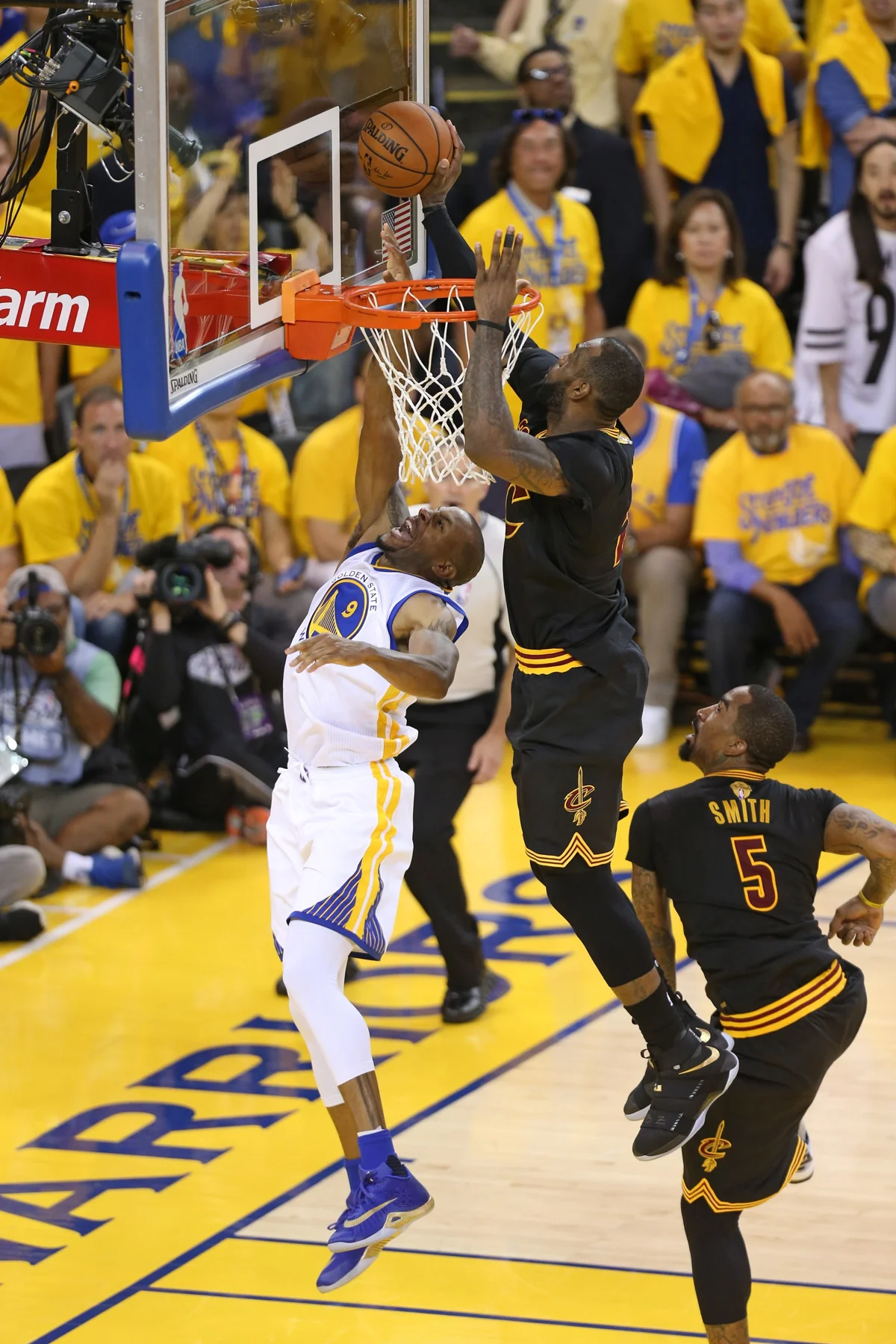
LeBron James catches Andre Iguodala at the rim
Game 7 of the 2016 Finals was tied 89–89 when James chased down Iguodala's fast-break attempt on June 19. Cleveland eventually won 93–89 and took the championship 4–3. The NBA's multiple-angle block video helps separate the initial transition advantage from the final contest.
J.R. Smith's challenge is part of the sequence. It complicates Iguodala's finish long enough for James to arrive from behind. James then needs a clean meeting with the ball, not simply enough speed to reach the backboard. The recovery combines sprinting, timing and control at a point when an uncontrolled collision could give the opponent free throws instead.
The block preserves the tie; it does not put Cleveland ahead. Later offensive execution, including Kyrie Irving's three-pointer, remains essential to the championship result. That makes this a useful antidote to highlights that credit a whole victory to one action. The stop matters precisely because it keeps the next possession meaningful.
Two Finals shots that changed the next possession
These two baskets changed a Finals game without ending it. Magic Johnson put his team in front; Ray Allen brought his team level. Both are better understood by watching the defensive possession that followed. A successful shot can transfer the pressure to the other team while leaving substantial work unfinished.
Magic Johnson's junior skyhook in Boston
On June 9, 1987, the Lakers beat Boston 107–106 in Finals Game 4. Johnson's late hook supplied the lead, and Los Angeles moved ahead 3–1 in the series. The NBA's junior skyhook replay shows a guard adapting a signature big-man scoring action to a crowded late-game situation.
Johnson receives the inbound on the left side, threatens a shot and moves into the middle. The defense has to react to his movement and size while still accounting for the basket behind it. Rather than stop for a conventional jumper directly into the help, he releases the moving hook above the contest. Its shape matters because the shooting arm creates an angle different from a normal pull-up.
The inbound begins with seven seconds remaining; the basket comes with about two left. Those are different clock readings, not competing descriptions of the same instant. Boston still gets a last attempt. A short highlight that ends at the hook can make the play appear to finish at the horn, which changes how a viewer interprets the defensive response.
Los Angeles ultimately won the series in six games. This basket's immediate consequence was a 3–1 advantage instead of a tied series. That is enough significance without treating Game 4 as the championship clincher. Watch the replay for the transition from receiving to threatening to releasing, a sequence that makes the celebrated shot possible.
Ray Allen finds the corner to keep Miami alive
Miami faced elimination in Finals Game 6 on June 18, 2013. Allen's three tied San Antonio 95–95 with 5.2 seconds left in regulation; the Heat later won 103–100 in overtime and forced Game 7. The NBA's official game-tying three video keeps the missed shot and offensive rebound in view.
Chris Bosh's rebound supplies the second chance after LeBron James misses. Allen then has to retreat to the corner, establish his feet behind the line and receive the pass ready to shoot. The boundary is crucial: two points would leave Miami behind. A few inches of positioning determine the shot's competitive value even before its accuracy becomes relevant.
Watch how quickly the rebound changes everyone's assignment. San Antonio must protect a three after first defending an initial attempt. Miami must find an eligible shot before time runs out. Allen's practiced footwork turns a hurried second opportunity into a controlled release, demonstrating that a possession can look chaotic while containing a precise individual action.
The Heat still needed overtime and then another complete game to win the championship. Allen's shot is a rescue rather than the final result. Comparing it with Johnson's hook makes a useful distinction: one late basket creates a narrow lead to defend, while the other earns the right to keep playing.
One finish that remains remarkable beyond the result
A list of great plays need not consist entirely of last-second decisions. Sometimes the achievement is the solution a player finds while moving through an apparently closed space. This final selection belongs for that reason. Its game context remains important, but the visual and technical difficulty can be appreciated without attaching a championship-winning claim to the basket.
Julius Erving goes behind the backboard in 1980
Philadelphia beat the Lakers 105–102 in Finals Game 4 on May 11, 1980. During that game, Erving produced his famous baseline reverse. The NBA's baseline-scoop footage shows a finish that changes shape after he leaves the floor. The league's historical profile places it within the first four games of the series.
Erving attacks along the baseline, then carries the ball behind the backboard and extends to finish on the opposite side. The board, rim and help defense make the direct route unattractive. His reach lets the release point move beyond the obstacle while his body continues along its original path. Control of the ball is as significant as the jump itself.
Watch the ball hand and the relationship between his shoulders and the backboard. The spectacular part is not simply staying airborne. It is maintaining a viable scoring angle while the ordinary angle disappears. A still photograph can convey the reach; the moving sequence reveals how late the solution becomes visible.
The win tied the series 2–2. Los Angeles eventually won the championship 4–2, so this is not the basket that gave Philadelphia that title. Its enduring reputation illustrates another reasonable criterion for a great play: an action can remain extraordinary even when its team does not win the larger competition. Technical imagination and historical consequence overlap, but they are not identical measures.
Across these ten moments, the most useful viewing habit is to restore one possession on either side of the highlight. Identify the score, clock and round; watch how the opportunity appears; then check what still has to happen afterward. That approach reveals Ehlo's preceding basket, Bosh's rebound, Johnson's cut and Smith's initial contest alongside the famous individual actions.
Use the NBA games today page to follow new moments as they develop, and the weekly schedule to plan your viewing. A future classic begins as a real possession with uncertainty attached. Keeping that uncertainty in the replay is part of understanding why the moment became memorable.
Sign in with Google to join the discussion.