NBA history · Evidence cutoff August 19, 2026
Greatest NBA Players of All Time: A Tiered Top 25 Ranking
Michael Jordan or LeBron James is only the first decision. A credible all-time list also has to compare Bill Russell's championship control with Wilt Chamberlain's records, Stephen Curry's spacing revolution with Magic Johnson's orchestration, and short overwhelming peaks with two decades of elite work. This ranking makes those tradeoffs explicit.
Editorial note: the NBA officially named an unranked 75th Anniversary Team. The order below is an independent editorial evaluation, not an NBA designation. Documented awards, records and championships establish the evidence; the weighting and final placements are judgment.
How this all-time ranking works — and the complete top 25
An all-time ranking cannot be calculated by adding rings, points and MVP trophies. Bill Russell played before blocks were an official statistic and before the Finals MVP existed for all but his last championship. Modern stars compete in a larger league with different spacing, travel, medical care and roster rules. The goal is therefore not to transport every player into one imaginary game. It is to ask how completely each player solved the basketball problems of his own era, how long he sustained that level and how well his value survived the postseason.
Six criteria, with no single-stat shortcut
1. Peak
How high was the player's best three-to-five-year level? This includes scoring and creation, defensive control, efficiency relative to the period and the ability to dictate a playoff series.
2. Sustained prime
One transcendent season is not a complete career. Longevity receives credit when the player remained a true championship driver, not simply when he accumulated late-career games and totals.
3. Playoff translation
Did the player's main advantages survive scouting, repeated matchups and tighter half-court possessions? Finals MVPs help after 1969, but complete postseason performance matters more than one award count.
4. Two-way impact
Elite offense carries greater individual leverage, yet defense can transform a team. Rim protection, switchability, rebounding and difficult perimeter assignments receive real weight.
5. Team value
Championships are evidence, not a solo statistic. The ranking considers role, teammate quality, system fit and whether a star could scale beside other great players without losing his defining value.
6. Era and innovation
Players are judged against their competitive environment, with credit for changing what teams believed was possible. The adjustment is cautious: it contextualizes results rather than inventing modern statistics for old games.
The order uses NBA careers as the main unit. Julius Erving's ABA peak matters because it helps explain his total basketball value, but the list does not simply combine two statistical books. Active players can still move. Nikola Jokić and Giannis Antetokounmpo, in particular, have already built all-time peaks without completing the longevity portion of their cases.
The complete tiered ranking at a glance
| Rank | Player | Tier | Core all-time case |
|---|---|---|---|
| 1 | Michael Jordan | GOAT cases | Peak scoring, elite guard defense, 6-for-6 Finals conversion |
| 2 | LeBron James | GOAT cases | Unmatched elite longevity and all-purpose playoff creation |
| 3 | Kareem Abdul-Jabbar | GOAT cases | Six MVPs, six titles and two decades of portable scoring |
| 4 | Bill Russell | GOAT cases | Era's defining defender and 11-time champion |
| 5 | Magic Johnson | GOAT cases | Transformative transition and half-court organizer |
| 6 | Larry Bird | Dynasty engines | Three straight MVPs and complete offensive command |
| 7 | Wilt Chamberlain | Dynasty engines | Unmatched statistical peak plus elite rebounding |
| 8 | Tim Duncan | Dynasty engines | Two-way structure for five titles across three decades |
| 9 | Shaquille O'Neal | Dynasty engines | Most overwhelming modern interior peak |
| 10 | Kobe Bryant | Dynasty engines | Two-way wing longevity and five championships |
| 11 | Hakeem Olajuwon | Inner circle | Historic defensive range and self-created post offense |
| 12 | Stephen Curry | Inner circle | Greatest shooter and an offensive geometry changer |
| 13 | Oscar Robertson | Inner circle | Big-guard creation decades ahead of its time |
| 14 | Jerry West | Inner circle | Elite playoff scorer, passer and defender |
| 15 | Kevin Durant | Inner circle | Portable, efficient scoring at unprecedented size |
| 16 | Moses Malone | Inner circle | Three MVPs and relentless possession creation |
| 17 | Nikola Jokić | Inner circle | Best passing-center peak and complete offensive control |
| 18 | Giannis Antetokounmpo | Historic greats | MVP-level rim pressure with DPOY defense |
| 19 | Julius Erving | Historic greats | ABA/NBA superstar who modernized above-rim wing play |
| 20 | Kevin Garnett | Historic greats | Switchable defensive organizer and versatile connector |
| 21 | Dirk Nowitzki | Historic greats | Spacing big whose scoring powered a singular title |
| 22 | David Robinson | Historic greats | Elite regular-season two-way center peak |
| 23 | Karl Malone | Historic greats | Extraordinary production and longevity |
| 24 | Charles Barkley | Historic greats | Hyper-efficient scoring and rebounding at 6-foot-6 |
| 25 | Dwyane Wade | Historic greats | Elite slashing guard with a championship-level two-way peak |
The list is more confident about tiers than single-slot gaps. Jordan and James have distinct but credible No. 1 cases. Hakeem through Jokić all have arguments several places higher depending on whether a reader privileges peak, longevity or offensive portability. The sections below show why each placement was made and what evidence keeps the player from the tier above.
Tier 1: The five strongest GOAT cases
These five players have the broadest answers to the greatest-ever question. Each combined an MVP peak, repeated championship-level postseason impact and a style that shaped elite team basketball. The order turns on different forms of dominance: Jordan's concentrated apex, James's unprecedented span, Kareem's balance of both, Russell's defensive championship control and Magic's command of team offense.
Ranks 1-2: Michael Jordan and LeBron James
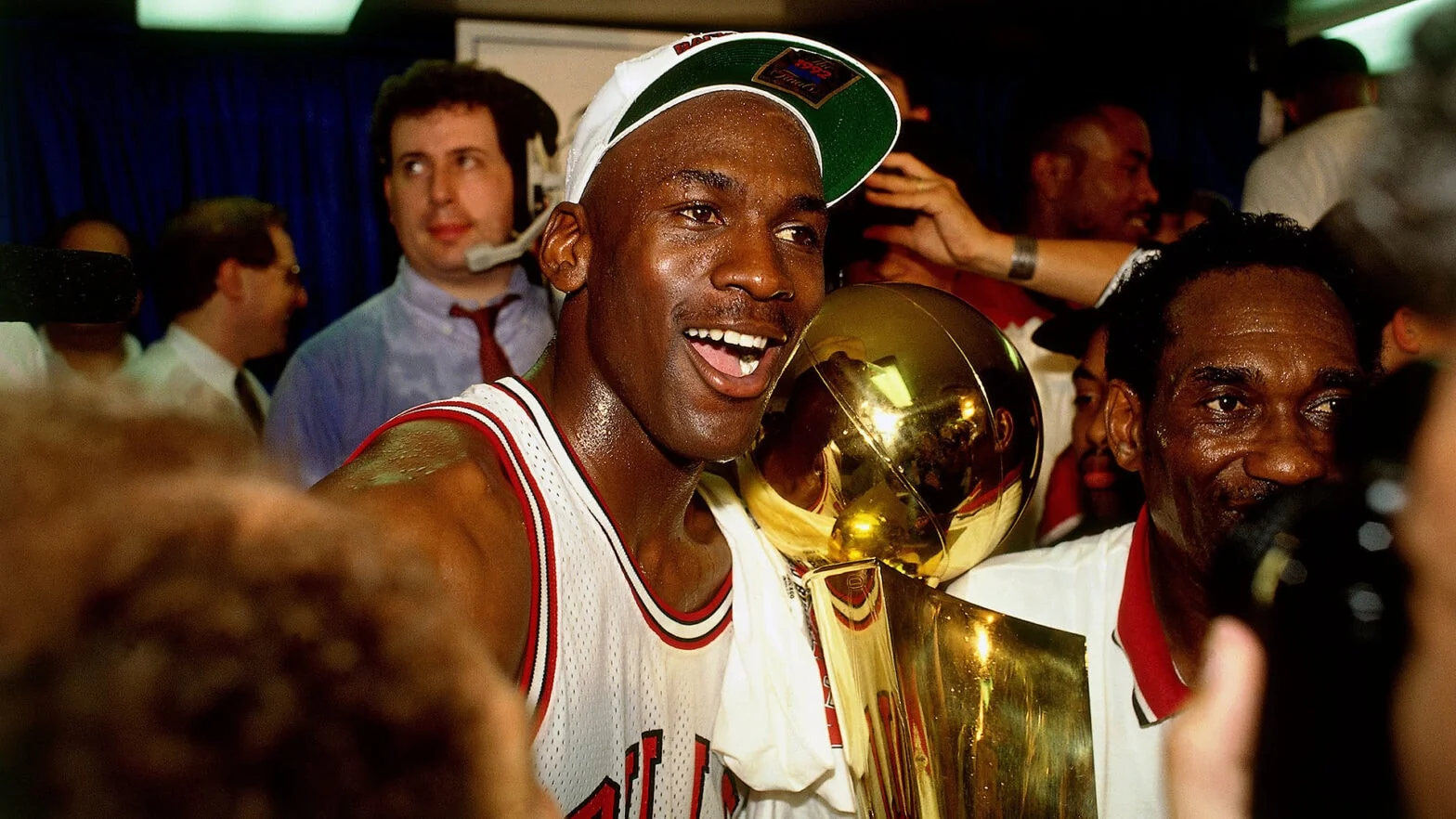
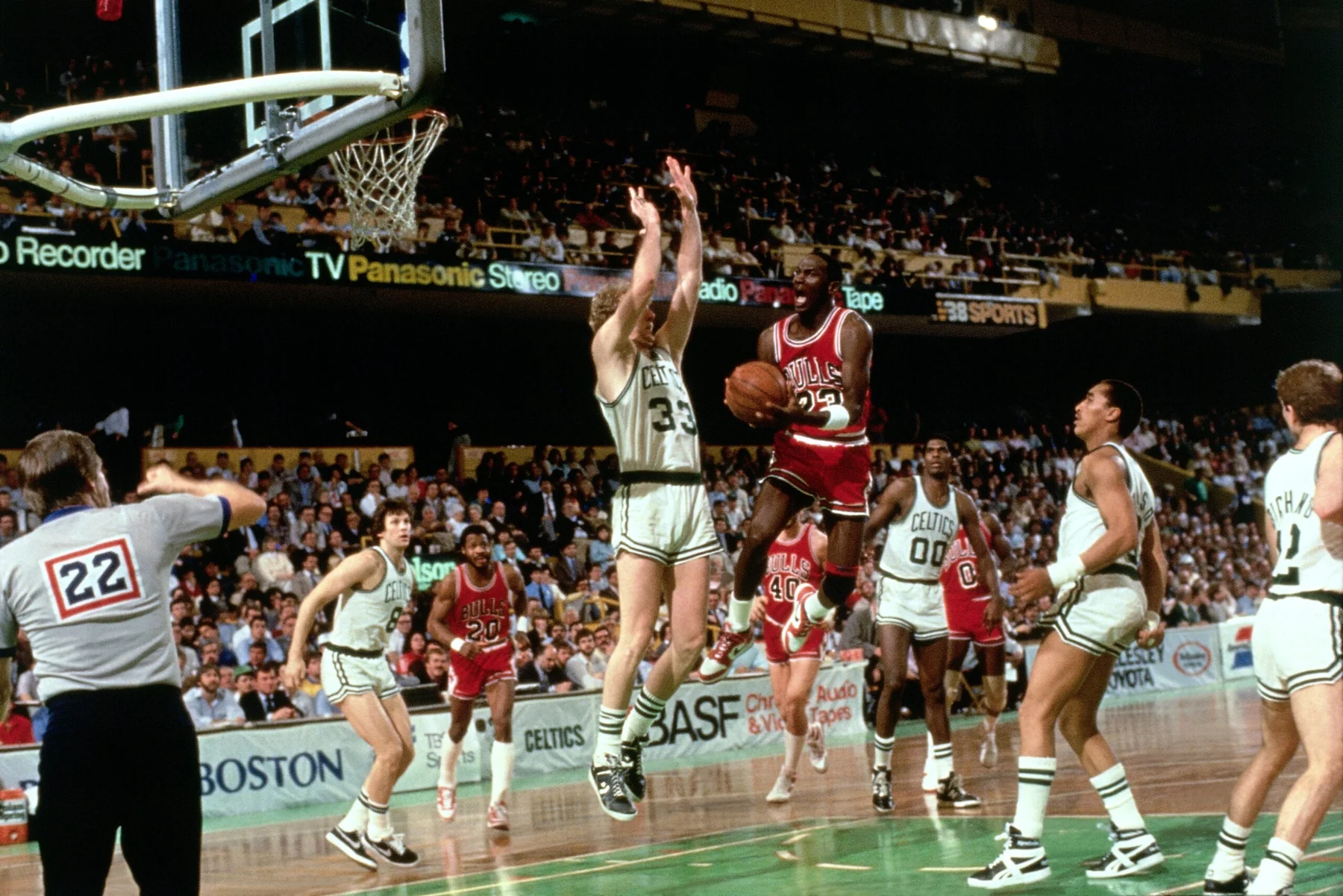
1. Michael Jordan
Jordan owns the strongest peak case because he was simultaneously the league's most reliable volume scorer and an elite defensive guard. His first step, vertical finishing and midrange counters made him resistant to different coverages, while his hands, anticipation and competitive motor created value away from the ball. Five regular-season MVPs measure the sustained dominance; six Finals MVPs in six championship trips show how cleanly it translated to the last series.
The argument is not simply “6-0.” A Finals record ignores every earlier playoff exit and overcredits one player for a team result. Jordan ranks first because the championship résumé sits on top of the scoring titles, playmaking growth and two-way peak—not because losing before the Finals would somehow be preferable. His main disadvantage against James and Kareem is career volume: two retirements interrupted what could have been an even larger total-value case.
2. LeBron James
James has the best longevity case in basketball history and perhaps the best floor-raising case. He became the NBA's regular-season and playoff scoring leader while operating as a primary passer, rebounder and, at his defensive peak, a switchable stopper and devastating transition eraser. Four championships and four Finals MVPs came with three franchises, evidence that his central skill—forcing help and solving the rotation—traveled across teammates and systems.
His playoff résumé contains more total creation and more deep runs than Jordan's, but also a few Finals in which the opponent or his own offensive limitations controlled the series. That is not a failure of longevity; it is part of a peak comparison. James is the defensible No. 1 choice for readers who weight 20-plus elite seasons more heavily. This list gives Jordan's best-season and best-postseason concentration the narrow edge.
Ranks 3-5: Kareem Abdul-Jabbar, Bill Russell and Magic Johnson
3. Kareem Abdul-Jabbar
Kareem offers the cleanest bridge between peak and longevity. His record six MVPs span Milwaukee dominance and the Showtime Lakers, while six championships show that his value fit more than one phase and roster. The skyhook was not merely iconic; it was a durable half-court solution that required little space or dribbling and remained useful deep into his career. Rim protection, rebounding and efficient interior scoring gave him two-way control before Magic eventually assumed more of the creation burden.
He ranks below James because James carried more total on-ball playoff creation, and below Jordan because Kareem's postseason apex was not as consistently decisive across his entire prime. Still, no résumé combines six MVPs, six rings and this length of elite production. Third is a placement within the GOAT debate, not outside it.
4. Bill Russell
Russell is the greatest defensive winner the league has known. Boston won 11 championships in his 13 seasons because his rim protection, rebounding and transition initiation changed the team's mathematical foundation. Five MVPs—voted by players in that era—show that contemporaries understood an impact that incomplete box scores cannot fully recover. Blocks were not official, and Finals MVP did not exist until his last title, so modern award-count comparisons systematically understate him.
Team concentration and a smaller league matter when contextualizing 11 rings, and Russell was not a high-volume half-court scorer. Those limitations place him fourth rather than making championships an automatic trump card. His defense, however, was not a supporting skill; it was the engine of the defining dynasty.
5. Magic Johnson
Magic turned passing into a system. At 6-foot-9 he could collect a rebound, lead the break, see over set defenses and punish switches inside. Five titles, three MVPs and three Finals MVPs capture a prime in which the Lakers' pace and half-court organization flowed through his decisions. His size let Los Angeles play without conventional positional boundaries long before that became common.
A shortened career and a smaller defensive footprint separate him from the top four. He also played with extraordinary teammates, especially Kareem, though his play amplified those teammates rather than merely benefiting from them. Magic remains the highest-ranked primary point guard because few players have ever made elite offense feel so inevitable.
Tier 1 contains five different answers to “greatest.” Jordan provides the apex, James the span, Kareem the blend, Russell the defensive team transformation and Magic the offensive team transformation. Moving one above another requires a declared value choice; none can be dismissed by a single statistic.
Tier 2: Era-defining engines who built dynasties
Tier 2 is not a consolation group. These five players were the central structures of multiple championship teams and owned peaks that can compete with anyone's. They sit just outside the first tier because one dimension—career length, postseason consistency, offensive breadth or two-way balance—is slightly less complete than the five cases above.
Ranks 6-8: Larry Bird, Wilt Chamberlain and Tim Duncan
6. Larry Bird
Bird's prime was a complete offensive operating system. He could score from the post or perimeter, create without monopolizing the dribble, rebound to start transition and deliver passes before the defense recognized the opening. Three consecutive MVPs from 1984 through 1986 capture how far he separated himself. Boston reached five Finals and won three titles during his era, with Bird taking two Finals MVPs.
He was not a lockdown isolation defender, but anticipation and rebounding made him a positive team defender. The constraint is longevity: back problems compressed his highest level and left him behind Magic in total postseason control. Bird ranks sixth because his shooting, passing and processing would scale beside almost any other star.
7. Wilt Chamberlain
Wilt produced numbers that still look fictional: 100 points in a game, 50.4 points per game in a season, 23,924 career rebounds and four MVPs. His athletic size bent roster construction, while later versions of his game proved he could reduce shooting volume, lead the league in total assists and anchor historically strong teams. Two championships prevent the lazy caricature that he could not win.
His playoff relationship with team offense was less consistently additive than the box-score peak suggests. Free-throw weakness and a tendency for enormous individual volume to crowd other creation are part of the evaluation, as is Russell's 7-1 playoff-series advantage over him. Seventh respects an unmatched physical and statistical peak without pretending every record translated equally to championship odds.
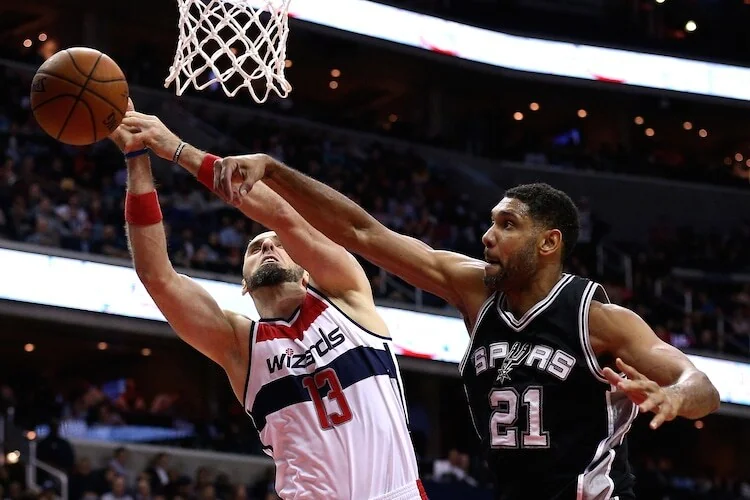
8. Tim Duncan
Duncan offered almost two decades of championship infrastructure. He could score from the block, screen, pass from the elbow, protect the rim, rebound and execute any coverage without demanding that the roster orbit his touches. The Spurs made the playoffs in all 19 of his seasons, and Duncan started for champions in 1999, 2003, 2005, 2007 and 2014. Three Finals MVPs and two regular-season MVPs show he was far more than a culture symbol.
His offensive ceiling was lower than Bird's or Wilt's, especially after his early prime. That lowers him in a greatest-player ordering even though his fit may be easier in an all-time lineup. Duncan is the model for low-maintenance superstar value: defense and decision-making that survived changing teammates, rules and roles.
Ranks 9-10: Shaquille O'Neal and Kobe Bryant
9. Shaquille O'Neal
Peak Shaq forced opponents to change personnel before the opening tip. His combination of mass, speed and touch generated deep catches, fouls and high-percentage finishes, then his offensive rebounding extended possessions. From 2000 through 2002 he won three straight Finals MVPs; in the 2000 Finals alone he averaged 38 points and nearly 17 rebounds. That is one of the clearest examples of a star defining the terms of a championship series.
His case loses ground through avoidable limitations. Free throws gave opponents an escape hatch, conditioning fluctuated and his longest elite stretch was shorter than Duncan's or Kobe's. No modern center has owned a more physically overwhelming three-year title peak, which is why he leads his longtime teammate here.
10. Kobe Bryant
Kobe supplied two decades of scalable wing creation. He could defend the opponent's best guard, operate without the ball beside Shaq, then become the primary difficult-shot maker for the 2009 and 2010 champions. Five rings, two Finals MVPs, one MVP, 11 First-Team All-NBA selections and nine First-Team All-Defensive selections reflect both role range and duration.
His shot-making solved possessions that had already gone wrong, but the same appetite produced lower efficiency and missed passing opportunities. That separates him from the more economical offensive engines above. Kobe ranks tenth because the full package—creation, defense, longevity and two distinct championship chapters—is stronger than a debate framed only around field-goal percentage.
Bird, Wilt, Duncan, Shaq and Kobe represent radically different superstar designs. Every one created a repeatable championship advantage; the separation is how often that advantage survived changes in health, teammates and playoff tactics. Their place outside Tier 1 reflects tiny comparative gaps, not a lack of historical dominance.
Tier 3: Inner-circle legends with top-10 arguments
Every player in Tier 3 has a plausible route into somebody's top 10. Hakeem can rise when defense and peak are emphasized. Curry can rise when offensive influence and scalability are emphasized. Robertson and West demand serious era adjustment, while Durant, Moses and Jokić combine historically rare skills with a résumé that is either less complete or still growing.
Ranks 11-14: Hakeem Olajuwon, Stephen Curry, Oscar Robertson and Jerry West
11. Hakeem Olajuwon
Hakeem owns one of the best two-way peaks ever. In 1993-94 he became the first player to win MVP, Defensive Player of the Year and Finals MVP in one season, then led a sixth seed through four rounds for a repeat title in 1995. His footwork created counters against elite centers, while his speed and timing let Houston switch, trap or protect the rim.
The case against a higher position is sustained offensive dominance: his scoring efficiency and team offenses were less consistently elite than the engines above. At his best, though, no center offered a broader answer to both ends. He is the first player outside the top 10 and the easiest Tier 3 name to move into it.
12. Stephen Curry
Curry altered the geometry of NBA offense. His shooting range pulls defenders beyond normal coverage, his movement forces communication away from the ball and his screening turns attention into teammates' layups. Two MVPs—including the first unanimous one—four titles and the 2022 Finals MVP establish that the effect survived deep postseason game-planning.
His size limits defensive versatility, and Golden State's best teams supplied exceptional defense and secondary creation. Yet his scalable offense is precisely why those lineups became more than their parts. Curry ranks behind Hakeem on two-way breadth and ahead of the remaining guards because he did not merely master an era; he helped create its dominant offensive language.
13. Oscar Robertson
Robertson was the prototype big creator decades before that role became fashionable. He averaged 30.8 points, 12.5 rebounds and 11.4 assists in 1961-62, won the 1964 MVP and made First-Team All-NBA nine straight times. At 6-foot-5 with strength, touch and court vision, he could dictate possessions without modern spacing.
His only title arrived beside Kareem late in his prime, and older assist conventions complicate direct numerical comparison. The ranking credits dominance relative to his environment rather than treating the triple-double as a magic phrase. Robertson's complete guard creation earns 13; limited team success keeps him below Curry.
14. Jerry West
West paired high-volume playoff scoring with passing and aggressive defense. He was an All-Star in all 14 seasons, made 12 All-NBA teams, later made five All-Defensive teams and carried Los Angeles to nine Finals. His 1969 Finals MVP remains the only one awarded to a player on the losing team, a reminder that individual series quality and team result are not identical.
One championship is the obvious résumé gap, but repeated losses to Russell's Celtics require context. West's shooting and secondary playmaking would translate easily; the three-point line would likely expand his value, though this list does not invent makes he never attempted. He lands one slot behind Robertson in an extremely close same-era guard comparison.
Ranks 15-17: Kevin Durant, Moses Malone and Nikola Jokić
15. Kevin Durant
Durant may be the most portable volume scorer ever: guard handle and shooting release in a near seven-foot frame, with enough off-ball skill to thrive beside other creators. Four scoring titles, an MVP, two championships and two Finals MVPs document the height of that advantage. His rim protection and switching also rose on Golden State's biggest stages.
The Warriors context makes the title evidence harder to isolate, and Durant has not anchored another champion despite excellent playoff stretches elsewhere. That does not erase the championships; it calibrates them. His longer elite scoring résumé places him above Moses and Jokić.
16. Moses Malone
Moses created possessions through relentless offensive rebounding and free-throw pressure. He won three MVPs, led the league in rebounding six times and was the decisive addition to a Philadelphia team that went 12-1 in the 1983 playoffs. That season ended with both regular-season and Finals MVP honors.
His passing and defensive range were narrower than the centers above, making his impact more concentrated in scoring and possession volume. He is often lost between stylistic eras, but a three-MVP center who dominated a title run belongs comfortably in this tier.
17. Nikola Jokić
Jokić has already reached a top-10-caliber offensive peak. His passing turns a center into the primary organizer, his touch punishes single coverage and his screening makes every handoff a multi-option action. In Denver's 2023 championship run he became the first player to lead an entire postseason in total points, rebounds and assists. Three MVPs confirm that it was no one-season eruption.
Rank 17 is a career-completeness decision, not a peak dismissal. At the August 2026 cutoff he has one title and fewer elite seasons than Durant or Moses. More healthy prime, another championship-level run or sustained defensive improvement can move him several places quickly.
Tier 3 is where weighting changes the list most. A peak-only draft could take Hakeem or Jokić much earlier. An innovation-first list could place Curry in the top 10. A longevity-heavy list would favor Durant or West. The order here balances all six criteria and keeps unfinished active careers open to revision.
Tier 4: Historic peaks, complete careers and the hardest cuts
The final tier contains players with MVP-level peaks and historically complete careers. Their cases are not weaker in every dimension; each has a trait that can outperform people ranked above him. The separation comes from the total portfolio: the length of the prime, playoff independence, two-way value and how often that value made a team a genuine title favorite.
Ranks 18-21: Giannis Antetokounmpo, Julius Erving, Kevin Garnett and Dirk Nowitzki
18. Giannis Antetokounmpo
Giannis combines transition force, relentless rim pressure and Defensive Player of the Year range. His 2019 and 2020 MVPs, 2020 DPOY and 2021 championship/Finals MVP create a compact résumé that already belongs here. At his best he can defend the rim, switch onto a handler and create an entire offense through drives, rolls and early-clock attacks.
Half-court shooting and late-game creation remain less flexible than Jokić's or Durant's, and his career is still active. Another long postseason peak would push him toward the top 15. Eighteenth recognizes that he has already reached a two-way level several players with longer careers never touched.
19. Julius Erving
Erving's complete professional case crosses the ABA-NBA merger. He won three ABA MVPs and two ABA titles, then added an NBA MVP and the 1983 championship in Philadelphia. His above-the-rim creativity expanded the public imagination of wing play, while his scoring, rebounding, steals and shot-blocking made the substance match the style.
This ranking primarily weighs NBA value, preventing a simple merger of two award ledgers. That choice lowers him relative to some all-pro-basketball lists. His ABA dominance still matters as evidence of peak ability, and his successful transition to the NBA makes No. 19 more than an influence award.
20. Kevin Garnett
Garnett was an unusually complete defensive organizer. He could protect the rim, show high against pick-and-rolls, switch, rebound and communicate the possession into shape. Offensively he passed, screened, hit midrange jumpers and operated as a connector. His 2004 MVP captures an enormous Minnesota carrying load; his 2008 DPOY and championship show how effectively that game scaled beside other stars.
He was not as forceful a late-clock scorer as Duncan or Dirk, and Minnesota's roster instability limited his prime playoff sample. Ranking him 20 rewards impact beyond points without pretending context resolves every offensive question.
21. Dirk Nowitzki
Dirk made a seven-footer's shooting a championship offensive foundation. His high release and one-legged fadeaway punished traditional bigs, while pulling a defender from the rim created lanes for everyone else. He won the 2007 MVP, scored more than 31,000 regular-season points and capped the case by beating a remarkable sequence of opponents for the 2011 title and Finals MVP.
His defense and passing were less expansive than Garnett's, which determines this close order. Offensively, Dirk was the superior playoff centerpiece. Readers who prioritize half-court championship creation can reasonably flip 20 and 21.
Ranks 22-25: David Robinson, Karl Malone, Charles Barkley and Dwyane Wade
22. David Robinson
Robinson's regular-season peak was spectacular: MVP, Defensive Player of the Year, a scoring title, a rebounding title and elite rim protection in an explosive seven-foot frame. He averaged 21.1 points, 10.6 rebounds and 2.5 blocks across his career, then adapted beside Duncan for two championships.
His self-created scoring was more vulnerable against elite playoff defenses than the centers ranked higher, most visibly in difficult matchups with Hakeem. The later titles add scalable two-way value but were no longer built around Robinson's offense. That peak-versus-postseason gap places him 22.
23. Karl Malone
Malone combined strength, transition running, screening, midrange touch and extraordinary durability. Two MVPs and 36,928 points document nearly two decades of high-volume production. His partnership with John Stockton created one of the sport's most repeatable regular-season actions and took Utah to consecutive Finals.
The postseason scoring peak was less resilient than the totals imply, and he never completed a title run. This list does not equate “no ring” with failure, but it does compare his late-round creation with Barkley, Robinson and the champions above. Longevity gives Malone the narrow edge over Barkley.
24. Charles Barkley
Barkley was a matchup violation at roughly 6-foot-6: an elite rebounder who could push the ball, score efficiently inside and create for teammates. He reached 20,000 points, 10,000 rebounds and 4,000 assists, won the 1993 MVP and drove Phoenix to the Finals in his first season there.
Defense, conditioning and a shorter sustained prime than Malone's limit the total case. His lack of a championship should not obscure how well the offense translated against larger defenders. Barkley at 24 is one of the clearest examples of peak quality exceeding ring count.
25. Dwyane Wade
Wade closes the list with one of the greatest guard championship peaks. In the 2006 Finals he averaged 34.7 points and drove Miami from an 0-2 deficit to four straight wins. His burst, body control, passing, help defense and unusual shot-blocking made him a complete two-way guard. Three titles, eight All-NBA selections and three All-Defensive selections extend the case beyond that one series.
Knee issues shortened his highest level, and limited three-point shooting made his off-ball fit less automatic than later guards. His best playoff run gives him the last position over candidates with longer primes but less championship-driving evidence.
The hardest omissions and why era comparison stays uncertain
Elgin Baylor was a pioneering high-volume wing and 10-time First-Team All-NBA selection. John Havlicek combined eight titles, stamina and two-way wing play. Bob Pettit won two MVPs and led the only team to defeat Russell's Celtics in a Finals. Isiah Thomas was the offensive leader of back-to-back champions. Each can enter a top 25 under a reasonable alternate weighting.
Chris Paul and John Stockton have extraordinary point-guard longevity and efficiency. Scottie Pippen may be the best scalable secondary wing ever. Kawhi Leonard owns a top-25 playoff peak but not the availability volume. James Harden owns a historic regular-season offensive peak but less consistent late-round translation. George Mikan, Bob Cousy, Rick Barry, Elvin Hayes, Patrick Ewing and Allen Iverson deserve the same serious historical conversation even when they miss this cutoff.
Why there is no perfect era conversion
Pace, lane width, the three-point line, illegal-defense rules, expansion, travel, medicine and global talent depth all changed. Blocks and steals were not officially tracked for much of Russell and Wilt's careers, and Finals MVP began in 1969. A responsible ranking can contextualize those differences; it cannot produce precise modern equivalents without inventing evidence.
The result is a tiered historical argument, not a permanent measurement. Jordan leads this version, James owns the best countercase, and every placement through Wade follows the same six declared criteria. Readers can disagree productively by identifying which criterion they weight differently instead of reducing 80 years of basketball to rings or one career total.
The all-time verdict
Michael Jordan is No. 1 on this list because his best years combined scoring pressure, elite guard defense and championship execution more completely than any rival. LeBron James is the closest challenger and the choice for readers who value total elite career volume most. Kareem Abdul-Jabbar, Bill Russell and Magic Johnson complete a first tier in which every player has a coherent GOAT case. The tiers matter more than pretending the distance between adjacent numbers can be measured exactly.
Sign in with Google to join the discussion.