The greatest NBA team is not automatically the team with the most regular-season wins. A champion must survive its own era, then an all-time comparison must ask how dominant, adaptable and complete that champion actually was.
This guide uses a visible scorecard and separates the best single-season peak from the strongest dynasty. The result is a top tier with reasons—not a fake simulation that pretends Bill Russell and Stephen Curry played under the same rules.
A Fair Way to Compare Great Teams Across Eras
An all-time ranking needs rules before it needs names. Otherwise the argument shifts whenever a favorite team is challenged: wins matter until a team has fewer wins; championships matter until a brilliant runner-up appears; depth matters until an older roster is discussed. This comparison begins with one non-negotiable filter: the candidate must have won the championship in the season being evaluated.
The five-part scorecard
- Regular-season dominance: record, margin relative to the league and consistency home and away.
- Postseason dominance: series control, elimination-game resilience and how decisively the team finished the title run.
- Opponent context: quality of the conference path and the opponent defeated in the Finals.
- Tactical completeness: creation, shooting or spacing for the era, defense, rebounding and the ability to change lineup shapes.
- Dynasty context: whether the season was an isolated spike or the apex of sustained championship-level performance.
The categories are deliberately not converted into a fake score to the second decimal. A 16-1 postseason is clearly extraordinary; assigning “9.6 portability points” to a team that never saw modern spacing is not. The scorecard makes judgments visible while leaving room for basketball reasoning.
The NBA's own 50th-anniversary panel offers a useful baseline. Its ten selected teams all won the title and averaged 66 regular-season victories, but that list stopped with the 1995-96 Bulls. It cannot answer for the Shaq-Kobe Lakers, the 2014 Spurs or the Kevin Durant Warriors. Those teams must be added using the same championship-first standard.
Why raw records require context
League size, travel, round length and playing style changed dramatically. The 1964-65 Celtics played 80 regular-season games in a nine-team league. The 1985-86 Celtics attempted only a small number of threes by modern standards. A current offense operates with a 24-second clock, a three-point line and a 14-second reset after many offensive rebounds—conditions that shape spacing, transition defense and shot selection.
Historical league averages underline the problem. Pace and three-point attempts vary so much that points per game cannot travel untouched from one era to another. The fair question is not “Would the 1965 Celtics know today's switch coverages on Monday?” Modern players did not invent their own accumulated knowledge, either. The fair question is how far a team separated itself from contemporary opponents and whether its core skills could be translated with reasonable preparation.
Postseason formats also matter. Earlier champions navigated fewer rounds, while modern champions face four best-of-seven series. That does not make an old championship easy; a smaller league concentrated talent and repeated matchups. It does mean a raw playoff win total cannot be compared without acknowledging opportunity.
Finally, single-season greatness and dynasty greatness are different awards. The 2000-01 Lakers were more terrifying in the playoffs than their 56-26 regular season suggests. Russell's Celtics present the opposite framing problem: choosing one season understates eight consecutive championships. This guide will identify both the brightest peak and the longest command of an era.
The Foundations: Russell's Celtics and the 1971-72 Lakers
Two early candidates define different kinds of greatness. Boston represents repeatability: a defense and culture that kept solving the league. Los Angeles represents the overwhelming single-season march: a record win total, a streak nobody has matched and a championship that completed the argument.
The 1964-65 Celtics as a dynasty snapshot
The 1964-65 Celtics went 62-18, a franchise high at the time, and won their seventh consecutive championship. Bill Russell averaged 24.1 rebounds and won MVP; Sam Jones supplied elite scoring; John Havlicek, K.C. Jones, Tom Heinsohn and Tom Sanders gave Red Auerbach layers of defense, transition play and decision-making. The famous Havlicek steal preserved a one-point Game 7 win over Wilt Chamberlain's Philadelphia team before Boston defeated the Lakers 4-1 in the Finals.
Boston's best case is not merely 62 wins. Opponents knew the system, played the Celtics repeatedly in a small league and still could not remove them. Russell turned defense into an organizing principle: protect the rim, finish the possession, then run. His passing after rebounds accelerated guards without requiring him to score like a modern first option.
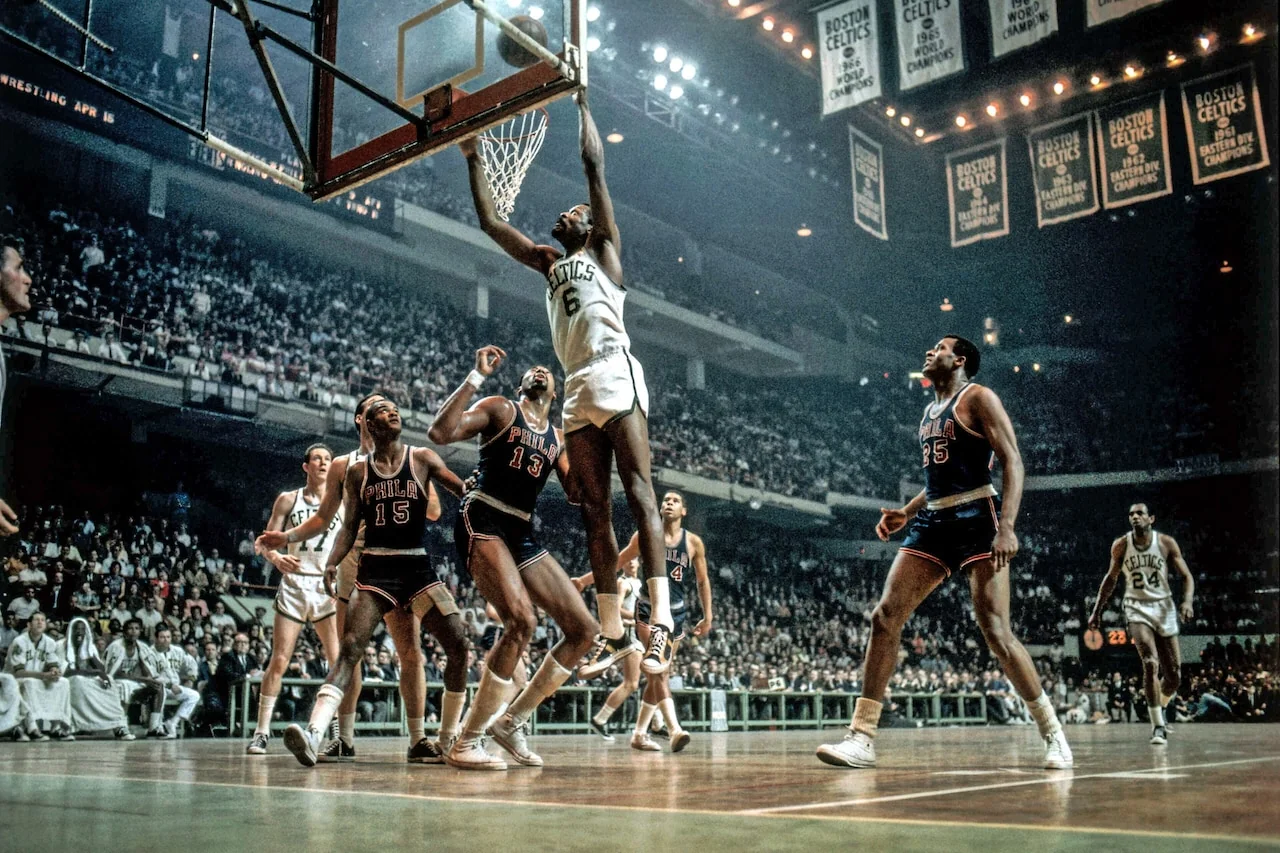
The portability question is size and spacing. Modern opponents would pull Russell into wider actions, but his mobility, anticipation and rebounding are exactly the tools a switching defense values. Boston's shooters would need to extend their range under modern rules. With an adaptation allowance for every historical team, the Celtics remain the dynasty standard even if another roster owns the sharper one-year peak.
The Lakers' 69 wins and 33 straight
The 1971-72 Lakers went 69-13 and won 33 consecutive games, still the NBA record. Jerry West led the league in assists, Gail Goodrich scored at volume, Wilt Chamberlain led the league in rebounding and Bill Sharman organized veterans into a more balanced team. Los Angeles led the league in points, rebounds and assists, then beat Chicago, Milwaukee and New York to claim the franchise's first championship in Los Angeles.
This roster scores well in every category. The regular-season dominance is obvious. The playoff path included Kareem Abdul-Jabbar's defending-champion Bucks, then a 4-1 Finals victory over the Knicks. Tactically, West and Goodrich offered dual creation while Chamberlain could dominate the glass without needing every shot. Happy Hairston and Jim McMillian added size and scoring around them.
The streak deserves context, not mysticism. A 33-game run requires health and schedule fortune, but it also demands repeated concentration across road trips and different opponents. Chicago later won more games, and Golden State later reached 73, yet neither approached 33 straight. The Lakers therefore remain the early benchmark for regular-season command with a title attached.
Between the two, Boston wins the dynasty category and Los Angeles wins the single-season résumé. That distinction will recur: the team most likely to own a decade is not always the team one would choose for a single seven-game series.
The 1980s Standard: The 1985-86 Celtics and 1986-87 Lakers
The league's 1980s revival produced two champions that remain templates. Boston showed how much skill could fit into a huge lineup; Los Angeles showed how a fast break could be a disciplined system rather than improvisation. Each had an MVP playmaker, multiple Hall of Fame-level options and a defense capable of delivering the ball back to the offense.
Boston's frontcourt and 40-1 home record
The 1985-86 Celtics finished 67-15 and an astonishing 40-1 at Boston Garden. Larry Bird won his third consecutive MVP while ranking among league leaders across scoring, rebounding, assists, steals and shooting. Kevin McHale supplied elite post scoring and length; Robert Parish ran the floor and protected the paint; Bill Walton, finally healthy enough for a reserve role, won Sixth Man of the Year.
That frontcourt was not merely big. It could pass. Bird read the entire floor, Walton kept actions alive from the high post, and McHale punished single coverage. Dennis Johnson defended guards and solved late possessions, while Danny Ainge provided quick decisions and shooting. Boston could grind through a half-court game without becoming predictable because the entry point kept moving.
The Celtics went 15-3 in the playoffs and beat Houston in six. The Rockets had eliminated the defending Lakers with Hakeem Olajuwon and Ralph Sampson, so Boston did not get the expected Finals rivalry. That is not a flaw in Boston's title; it is a reminder that bracket difficulty cannot be reduced to famous names. The Celtics beat the opponent that beat Los Angeles.
Against a modern spread offense, Boston would need Ainge and Bird to take more threes and might use McHale as a switching center. The personnel supports that translation: intelligent passers, multiple rim defenders and a superstar who created advantages without monopolizing the ball.
Showtime at its most complete
The 1986-87 Lakers answered with a 65-17 season and a 15-3 playoff run. Magic Johnson averaged a career-best 23.9 points and led the league with 12.2 assists, winning MVP. Pat Riley shifted more offensive responsibility from the 39-year-old Kareem Abdul-Jabbar toward Magic, while James Worthy, Byron Scott and A.C. Green filled lanes and Michael Cooper won Defensive Player of the Year.
“Showtime” was built on roles. Johnson rebounded and advanced before the defense formed. Worthy sprinted into scoring position, Scott widened the court, and Kareem remained a half-court solution when transition disappeared. Cooper let the Lakers defend the best perimeter creator without exhausting Magic. Mychal Thompson, acquired during the season, added frontcourt depth for the playoff run.
Los Angeles won 11 of its first 12 playoff games, then beat Boston 4-2 in the Finals. The famous Magic junior sky hook in Game 4 captured the matchup advantage: a 6-foot-9 lead creator could post, pass or shoot over smaller defenders. That size would remain disruptive in any era, particularly with modern spacing around him.
Boston owns the slightly better regular-season record and the nearly perfect home mark. Los Angeles owns the direct Finals victory over the rival core a year later and a more obvious transition to modern perimeter play. The honest verdict is a shared tier: choose Boston for frontcourt control and half-court passing, Los Angeles for pace, matchup creation and open-floor pressure.
The 1995-96 Bulls Set the Modern Benchmark
The 1995-96 Bulls are the easiest all-time choice to defend because there is no missing achievement to explain away. They won 72 regular-season games, controlled the playoffs, beat a 64-win Finals opponent and stood inside a six-championship dynasty. Their case joins peak and continuity instead of asking voters to choose between them.
A 72-10 season with no unfinished business
Chicago started 41-3 and finished 72-10, then went 15-3 in the postseason. Michael Jordan led the league in scoring and won regular-season MVP, All-Star MVP and Finals MVP. Scottie Pippen joined him on the All-NBA First Team, Dennis Rodman led the league in rebounding, Toni Kukoč won Sixth Man of the Year and Phil Jackson won Coach of the Year. It was dominance distributed across a functioning roster, not a superstar dragging a weak group.
The playoff sequence strengthens the record. Chicago swept Miami, beat New York 4-1, swept an Orlando team that had eliminated the Bulls the year before and took the first three Finals games from Seattle. The SuperSonics won Games 4 and 5, forcing Chicago to close at home. A 4-2 Finals is less pristine than a sweep, but responding after the first consecutive losses of the postseason is evidence, not a blemish.
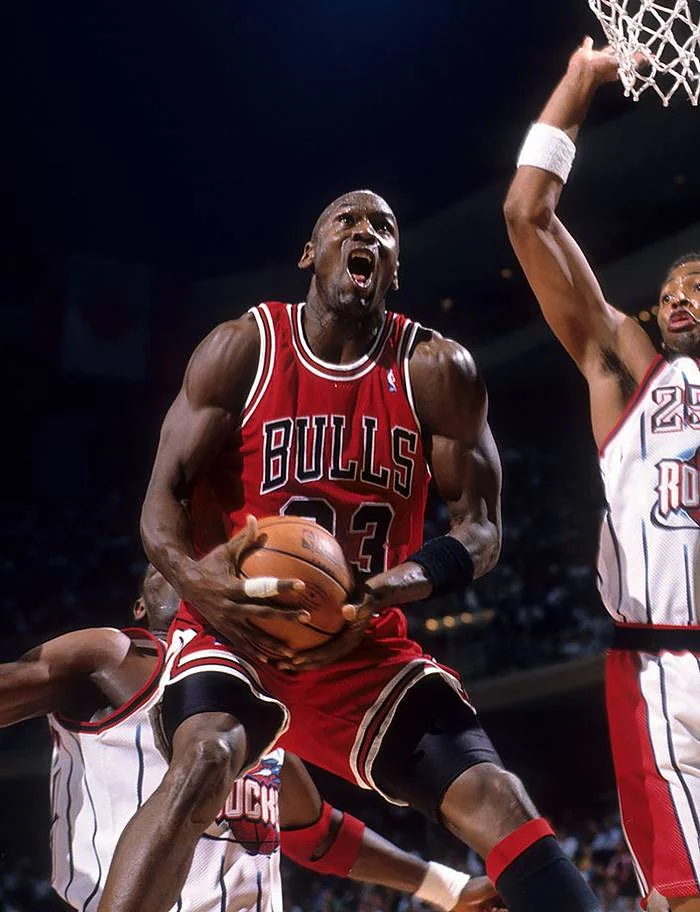
The Bulls' 12.3-point average margin matched the best figure cited in the club's historical account, and their 33 road wins showed the performance was not a home-court artifact. Winning 87 of 100 combined regular-season and playoff games is the simplest summary of sustained excellence.
Why Chicago travels well across styles
Jordan and Pippen make the roster portable. Both could create, post, defend multiple perimeter positions and punish switches. Ron Harper added another large guard, allowing Chicago to deploy disruptive size across the backcourt. Rodman could rebound against centers, switch actions and create extra possessions without needing plays called for him.
The offense would look different today. Chicago used the temporarily shortened three-point line of the mid-1990s and did not build around the volume a modern team expects. Yet Steve Kerr and Kukoč provided shooting, while Jordan and Pippen created paint touches and passing windows. A modernized version would move a big away from the lane more often and turn long twos into threes. The underlying advantages—two elite wing creators and defenders plus historic offensive rebounding—remain.
The center position is the main matchup question. Luc Longley, Bill Wennington and occasional smaller lineups handled the era's interior demands. Against a five-out offense, Chicago would likely close with Rodman or Kukoč at center and switch more. Against Shaquille O'Neal, it would need Longley's body and aggressive help. The roster could change shapes without removing its best player.
That is why the Bulls hold the benchmark spot. The 2017 Warriors have a stronger shooting argument and the 2001 Lakers a more dominant playoff record, but Chicago offers the cleanest complete file: historic wins, huge margin, elite opponents defeated, adaptable stars and a championship before and after the season.
Modern Peaks: The 2000-01 Lakers, 2013-14 Spurs and 2016-17 Warriors
Modern contenders expose the weakness of any single metric. The 2001 Lakers won “only” 56 regular-season games but nearly swept the playoffs. The 2014 Spurs won through synchronized movement rather than two peak scorers. The 2017 Warriors combined a 67-win season with the best playoff record of the four-round era.
Postseason force versus collective precision
The 2000-01 Lakers went 15-1 in the playoffs. They swept Portland, Sacramento and a 58-win San Antonio team, then lost Game 1 of the Finals in overtime before winning four straight against Philadelphia. Shaquille O'Neal averaged 33.0 points and 15.8 rebounds in the Finals; Kobe Bryant had already become a two-way superstar capable of taking over perimeter matchups.
The concern is the 56-26 regular season. Injuries and uneven urgency kept Los Angeles from dominating wire to wire, so its full-season case trails Chicago and Golden State. But for a seven-game series, the Lakers may be the hardest matchup on the board. Few historical rosters have a center large enough to guard O'Neal without constant help, and every double-team gives Bryant, Derek Fisher, Rick Fox and Robert Horry clearer decisions.
The 2013-14 Spurs present the opposite aesthetic. They went 62-20, used extraordinary depth and returned to the Finals after their 2013 heartbreak. Gregg Popovich's choice to start Boris Diaw in Game 3 amplified passing and spacing. San Antonio then beat Miami by 19, 21 and 17 points to close the series, finishing with a plus-70 differential—the largest in Finals history at the time cited by the NBA review.
Tim Duncan, Tony Parker and Manu Ginóbili still anchored the team, but Kawhi Leonard earned Finals MVP and the ball rarely stuck. The Spurs' case rests on collective precision: drive, help, pass, repeat until the defense breaks. Their 16-7 playoff record lacks the near-perfect shine of Los Angeles or Golden State, yet the final three games against a two-time defending champion are among the strongest sustained stretches ever played on the Finals stage.
Golden State's two-way ceiling
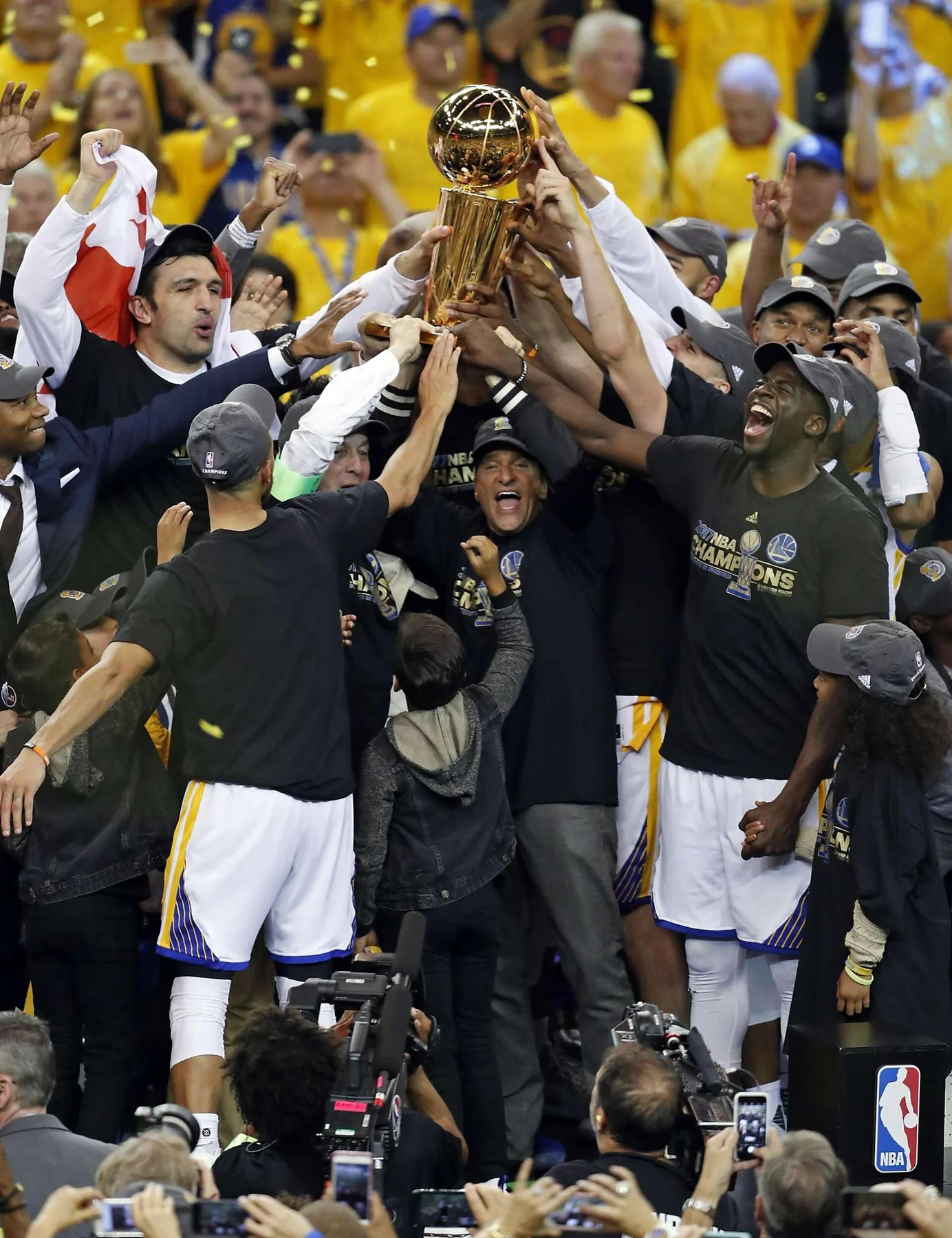
The 2016-17 Warriors went 67-15 and 16-1 in the playoffs. Kevin Durant joined a 73-win core containing Stephen Curry, Draymond Green and Klay Thompson, with Andre Iguodala still supplying championship-level wing defense and playmaking. Golden State swept the Western Conference bracket and beat Cleveland 4-1, with Durant scoring at least 30 in every Finals game on his way to MVP.
The offensive dilemma was unprecedented. Trap Curry and Green attacked four-on-three with Durant and Thompson available. Switch and Curry or Durant isolated a weaker defender. Stay home and the screen created enough separation for a historic shooter. On defense, Green organized switching and help while Durant protected the rim, Thompson took guards and Iguodala handled elite wings.
Critics sometimes treat the roster's talent as a reason to disqualify it. That reverses the question. “Greatest team” evaluates the team that existed, and fitting multiple stars without sacrificing defense is part of the achievement. The more relevant criticism is opponent injury context in the West, including Kawhi Leonard's injury in the conference finals. Even after acknowledging it, 16-1 across four rounds is too powerful to dismiss.
These three teams win different subcategories: the Lakers for most frightening playoff force, the Spurs for collective execution, and the Warriors for the highest modern blend of shooting, creation and switchable defense. The Bulls remain the fuller season benchmark; Golden State is the strongest rival for a single series.
The Verdict: Best Single Season, Best Dynasty and Best Team for a Series
A single ordered list hides more than it reveals. The clearest verdict awards three different questions, then places the remaining champions in tiers. Every winner must have completed the season with a title; every cross-era matchup remains conditional.
Tiered conclusions instead of false certainty
| Question | Choice | Why |
|---|---|---|
| Best complete single season | 1995-96 Bulls | 72-10, 15-3, huge margin, elite Finals opponent and dynasty context |
| Best dynasty | Russell Celtics | Eight straight championships and 11 in 13 seasons |
| Best neutral-rule series roster | 2016-17 Warriors | Two MVP creators, historic shooting and switchable defense |
| Most dominant playoff run | 2000-01 Lakers | 15-1 with three Western Conference sweeps |
Tier 1: 1995-96 Chicago and 2016-17 Golden State. Chicago has the cleaner full-season résumé; Golden State has the most difficult offensive personnel to solve in a modern setting. A ballot that reverses them is defensible if its weighting favors matchup ceiling over regular-season achievement.
Tier 2: 1964-65 Boston, 1971-72 Los Angeles, 1985-86 Boston, 1986-87 Los Angeles and 2000-01 Los Angeles. Each has a category strong enough to win the debate—dynasty continuity, 33 straight, home dominance, transition completeness or a 15-1 playoff run—but one contextual question keeps it below the two-team peak tier.
Tier 3: 1982-83 Philadelphia, 1988-89 Detroit, 2013-14 San Antonio and several other champions. “Third tier” here still means one of the best teams ever. Moses Malone's 76ers went 12-1 in the playoffs; Detroit went 15-2; the Spurs produced a historically decisive Finals. The line between tiers is comparative, not dismissive.
The matchup thought experiment
For a Bulls-Warriors series, define the environment first. Give both teams a training camp under a blended modern rule set, use the current three-point line, allow zone principles and officiate perimeter contact consistently. That avoids forcing Golden State into 1996 overnight or asking Chicago to discover 2017 spacing during warmups.
Golden State would try to pull Rodman or Longley away from the rim, use Curry's screens to force communication and let Durant attack a tilted floor. Chicago would place Pippen and Harper into the ball action, use Jordan to punish smaller switches and attack the offensive glass. Rodman at center improves the Bulls' switching but makes rim protection smaller; Longley improves size but gives Curry a screening target.
The narrow pick is Golden State because Curry-Durant actions can produce efficient shots even against correct defense, and Green-Iguodala-Thompson provide enough defensive options to survive. It is not a prediction of an easy series. Chicago owns the stronger individual perimeter stopper, the more relentless offensive rebounder and the best late-game scorer of its era. Six or seven games is the reasonable expectation.
Change the rules and the answer can change. Permit the 1990s degree of hand-checking while limiting modern defensive zones, and Chicago gains. Play by current spacing and freedom-of-movement expectations, and Golden State gains. That sensitivity is the lesson: the best historical comparison explains its assumptions instead of presenting imagination as data.
The final answer is therefore plural but decisive. The 1995-96 Bulls own the best completed season, Russell's Celtics own the dynasty crown, and the 2016-17 Warriors are this guide's choice for one prepared neutral-rule series. Greatness survives disagreement when the criteria remain visible.
The short answer
Pick the 1995-96 Bulls for the greatest complete season, Russell's Celtics for the greatest dynasty and the 2016-17 Warriors for a neutral-rule seven-game matchup.
Sign in with Google to join the discussion.