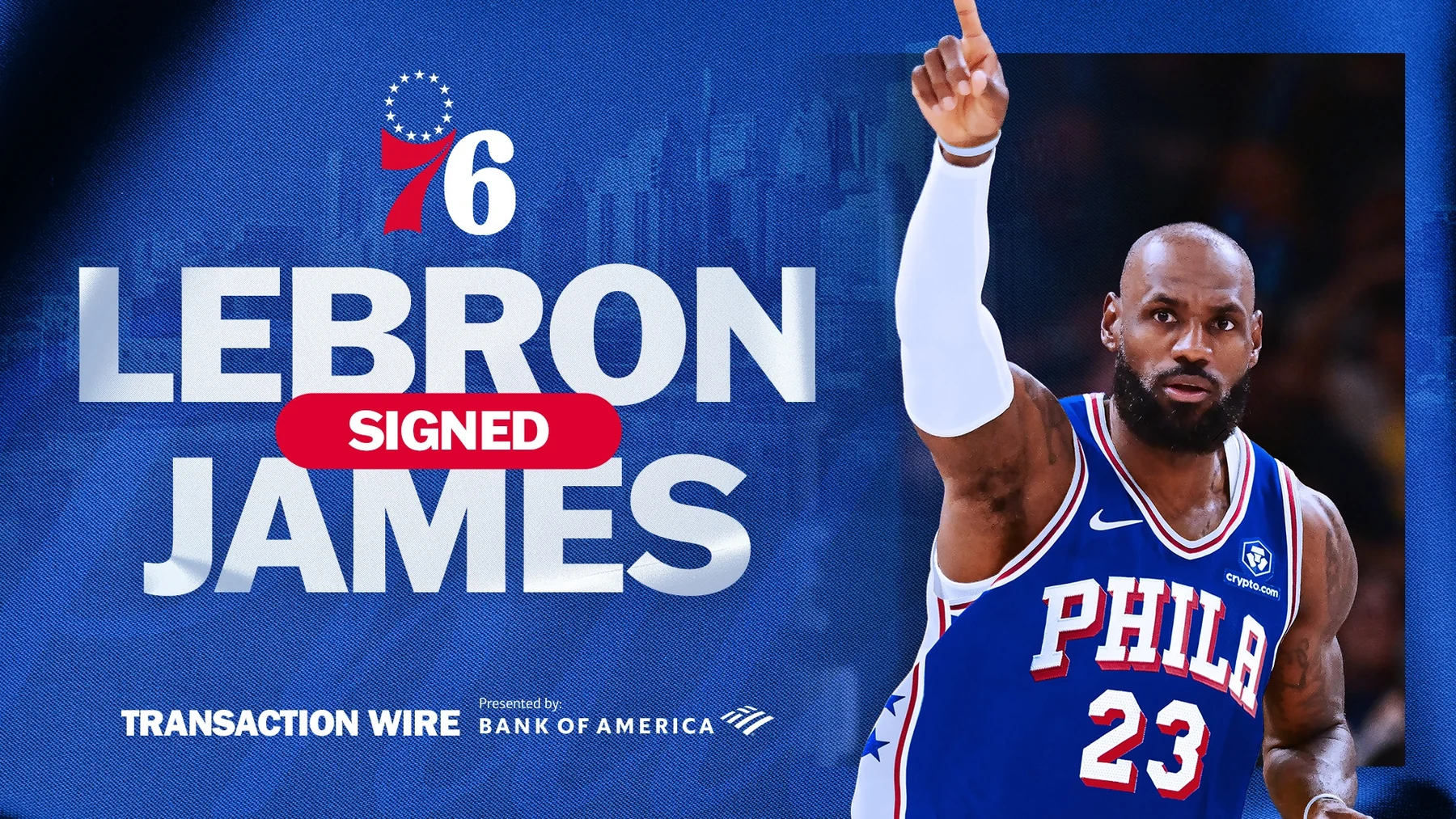
LeBron James is a Philadelphia 76er. The club made the move official on July 27, 2026, ending the retirement speculation and giving an already loaded Eastern Conference contender its most experienced organizer. The headline is historic; the basketball question is more practical. Philadelphia must combine James with Tyrese Maxey, Jaylen Brown, VJ Edgecombe and Joel Embiid without asking a 41-year-old to carry an 82-game offense.
LeBron James is officially a Philadelphia 76er
The Sixers announced the signing through president of basketball operations Mike Gansey. James called it his “last decision” after seriously considering retirement, presenting Philadelphia as one final championship run. The language matters: this is a veteran choosing a ready-made contender, not a franchise asking him to begin another multiyear rebuild.
Contract terms and what “last decision” means
Philadelphia's release followed team policy and did not disclose terms. Reporting from AP and ESPN placed the deal at two years and roughly $8 million on a veteran-minimum structure. That distinction should remain explicit until the contract record supplies every option detail. What is clear is that James accepted far less than a star salary, allowing the Sixers to add his playmaking without dismantling the expensive core already built around Embiid and Maxey.
The move returns James to the Eastern Conference after eight Lakers seasons. It also gives him a chance to win with a fourth franchise after championships in Miami, Cleveland and Los Angeles. That history raises expectations, but his quote about making Philadelphia a championship team is an objective, not proof that the roster has solved health, shooting or late-game role allocation.
What Philadelphia actually added at age 41
The official announcement listed 43,440 career points, 22 All-Star selections and 21 All-NBA selections. More relevant to 2026-27 is his latest season: the Sixers' player page lists 20.9 points, 7.2 assists and 6.1 rebounds across 60 games in 2025-26. He is no longer asked to win every possession through rim pressure, yet he remains a large playmaker who can diagnose a rotating defense, deliver cross-court passes and punish smaller defenders.
Philadelphia added a half-court problem solver and transition passer. James can initiate while Maxey attacks a tilted floor, screen to create a switch for Brown, or work from the elbow with Embiid occupying the defense. The risk is role inflation. If the Sixers treat his name as permission to play him 38 minutes in November, they reduce the chance that his decision-making is available in May. His value rises when the roster lets him choose the highest-leverage possessions.
How the new starting five can function
The projected group—Maxey, Edgecombe, Brown, James and Embiid—does not need one permanent point guard. It needs a possession hierarchy. Maxey supplies speed, James supplies diagnosis, Brown supplies force against switching wings, and Embiid bends the floor from the post and foul line. Edgecombe's cutting, defense and willingness to take open threes connect those higher-usage pieces.
Maxey keeps the pace while LeBron organizes
Maxey should still push after makes and misses. Asking James to walk the ball up every time wastes the younger guard's greatest stress point: defenders retreating before they build a wall. In the half court, James can initiate enough to release Maxey for movement threes, handoffs and second-side drives. That exchange matters more than which player is listed at point guard.
The minutes can be staggered so at least one is always creating. When both play, Maxey's shooting stretches the help James attracts. When James rests, Maxey returns to a heavier pick-and-roll diet. When Maxey rests, James can slow the game and feed Brown or Embiid at their preferred spots.
Brown solves difficult wing possessions
Brown's role may require the clearest sacrifice. His usage will fall from the level he carried before arriving, yet his ability to beat a switch without a complex setup is exactly what a crowded star lineup needs. He can attack a rotating defense after an Embiid double, screen for James to force a smaller matchup, and take the toughest perimeter assignment so the older forward is not chasing guards all night.
The concern is shared midrange appetite. Brown, James and Embiid all operate comfortably inside the arc. Philadelphia must turn that overlap into sequence—one player creates the rotation, the next attacks it—rather than three players waiting for separate isolations.
Embiid–LeBron actions will decide the ceiling
An Embiid–James two-man game forces uncomfortable choices. Switch and a guard may end up on Embiid; stay home and James can turn the corner; show two defenders and Maxey or Edgecombe receives the release pass. James can also screen for Embiid, a reversal of the obvious alignment that makes the defense decide whether to switch before the center catches.
Spacing is the constraint. None of the projected five should be treated as an automatic 40% standstill shooter, so Nick Nurse will need empty-corner actions, purposeful cuts and quicker decisions. The lineup's talent creates advantages; clean geometry determines whether those advantages end in a layup or two teammates occupying the same help defender.
The rotation questions behind the star names
A famous starting five does not play 240 minutes. Philadelphia's season will turn on the combinations that survive when two stars sit, especially on back-to-backs and during Embiid rest games. The bench is built around clearer specialists than the starters.
Shooting and spacing around four creators
Anfernee Simons supplies instant pull-up range and can punish defenses that duck under screens. Dean Wade offers lower-usage size, catch-and-shoot spacing and defensive flexibility. Those traits matter because James, Maxey, Brown and Embiid create enough initial advantages; the supporting group must finish them without demanding another isolation.
Maxey's own shot profile offers a clue. NBA.com reported that he made 41.7% of his catch-and-shoot threes last season compared with 33.5% of pull-ups. More James initiation can shift some difficult pull-ups into cleaner catches. The tradeoff is defense: Simons adds offense but smaller guard combinations can be targeted, so Wade or a defensive wing may need to balance those units.
Who carries non-Embiid minutes
The Sixers should resist making James the default small-ball center every time Embiid sits. That lineup can create five-out offense, but the rebounding and physical burden are poor regular-season investments for a 41-year-old. Adem Bona and Ariel Hukporti give Nurse actual center options; Wade can cover selected small units rather than every backup minute.
Bench scoring and deep pick-and-roll range.
Spacing, switchability and low-maintenance minutes.
Rim protection, screens and regular-season size.
A useful stagger keeps two of Maxey, Brown, James and Embiid on the floor. That reduces the need for any bench player to impersonate a star and lets Edgecombe develop through meaningful secondary creation. Camp will determine the final order; the roster logic already says Philadelphia needs function, not another collection of names.
Health and workload matter more than the opening-night lineup
James played 60 games in 2025-26. Embiid's recent availability record makes any full-season projection uncertain, even though Nurse has expressed optimism. Philadelphia should therefore measure success by healthy, connected minutes near the postseason, not by maximizing the number of October games in which all five starters cross 35 minutes.
The roster gives Nurse several load-management tools. Brown and Maxey can carry primary scoring when James sits. James can organize non-Embiid offense without asking the center to absorb every post touch. Simons can create bench points, while Wade and the young centers absorb less glamorous physical assignments. Those are structural reasons to reduce strain, not guarantees that injuries will disappear.
A sensible regular-season test
- Can James stay effective without leading the team in minutes?
- Can Philadelphia defend and rebound when Embiid rests?
- Can Maxey and Brown win games when one older star is unavailable?
- Can the best five build enough repetition before playoff seeding tightens?
Back-to-backs deserve particular attention. The 2026-27 NBA schedule creates spots where playing both veterans may offer little long-term value. Rest decisions will frustrate ticket buyers, but transparent injury reporting and a capable second unit are better than pretending age and medical history do not exist.
A championship roster is not the lineup with the most awards in its biography. It is the lineup that reaches April with defined roles, viable counters and enough health to execute them. The Sixers have unusually high upside and unusually obvious availability risk. Both statements can be true.
The 2026-27 schedule checkpoints that will reveal the fit
Opening night will attract the loudest conclusions and provide the smallest useful sample. Philadelphia's first month should be read as a sequence: which player initiates, how Nurse staggers the four established creators, whether the starting group generates clean threes, and how the defense holds up when Embiid leaves.
What to watch in the first 20 games
The road opener against the defending champion Knicks at Madison Square Garden is an immediate pressure test, but it will not settle the season. More revealing will be repeated possessions against switching teams, the first back-to-back, and the first game one of James or Embiid misses. The Sixers' NBA Cup group games run from October 30 through November 27, adding high-attention matchups before the rotation is fully mature.
- Shot quality: track open catch-and-shoot attempts, not only team three-point percentage.
- Staggering: see whether at least two primary creators anchor each competitive unit.
- Closing five: the starter label matters less than who defends and spaces in the final six minutes.
- Workload: compare minutes and back-to-back availability with game importance.
How to follow every Sixers game
The league's national inventory is split among Disney networks, NBCUniversal outlets and Prime Video, while local availability varies. Start with the site's NBA TV schedule for channel and streaming context, then use the Philadelphia 76ers schedule for the team view. Confirm late broadcast changes and injury status on game day.
The signing changes Philadelphia's ceiling because James can solve possessions the roster previously asked Maxey or Embiid to create alone. It does not remove the work. Nurse must preserve pace, space four high-usage players, build credible non-Embiid groups and manage two veteran bodies through the calendar. If those pieces hold, the Sixers have enough creation to enter any playoff series with answers. The first 20 games will show whether the names are becoming a system.
The first useful benchmark is turnover quality. A lineup with this much passing will commit some turnovers while testing windows; those are different from dead-ball giveaways caused by indecision or crowded spacing. Live-ball mistakes expose an older frontcourt in transition. Philadelphia should accept ambitious passes that create rim pressure while reducing casual cross-court reversals and late-clock handoffs.
The second benchmark is defensive assignment. Brown and Edgecombe can take difficult perimeter matchups, freeing James to guard a less mobile forward and conserve bursts for help defense. Maxey's size will still attract screening actions. The answer cannot always be Embiid cleaning up at the rim, especially on nights his minutes are limited. Watch whether the weak-side wing tags rollers early and whether the guards rebound long misses; those details decide if the group can get into the transition game it wants.
Finally, resist measuring chemistry only through wins. A soft opponent can be beaten with talent even when the process is poor, and a contender can expose a new coverage before Nurse has installed the counter. Better signs are repeatable: two-side actions instead of one pass and a shot, quick entry passes to Embiid, James screening without the ball, and role players taking open attempts. By the end of the Cup window, those habits should be visible even if the final playoff rotation is still months away.
Home and road performance can reveal another layer. Veterans often communicate coverages more easily at home, while a new group on the road must solve crowd noise, reduced practice time and late-game execution without a familiar rhythm. A clean road possession after a timeout—correct spacing, one decisive advantage and a shot generated before the clock becomes an enemy—is a stronger sign of readiness than a spectacular individual make. Philadelphia has enough shot makers to rescue broken possessions; its title case depends on needing fewer rescues as the calendar advances.
Sign in with Google to join the discussion.