Why the NBA 75 team has 76 players
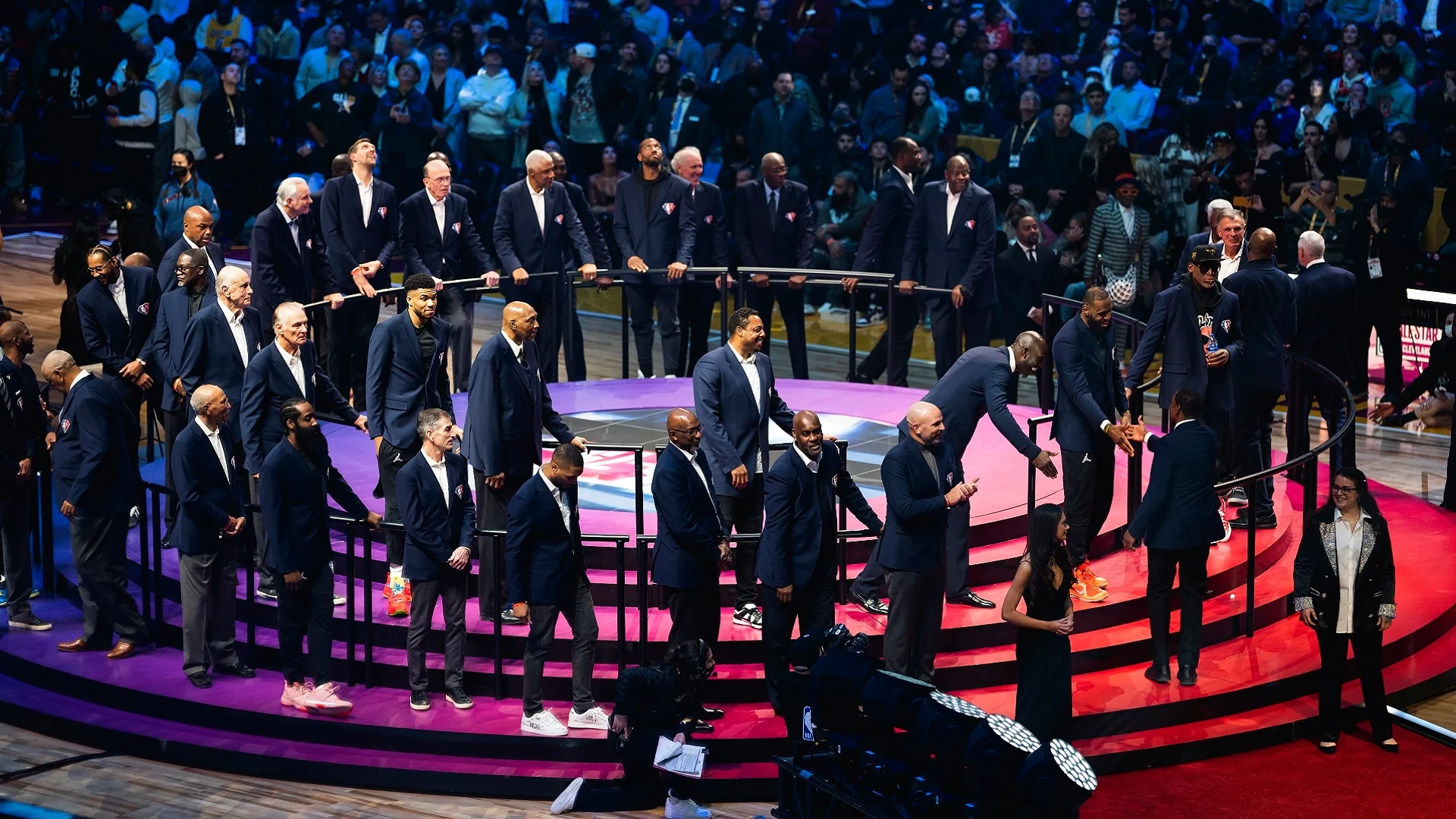
The NBA 75th Anniversary Team officially contains 76 players. The league planned to honor 75, but a tie in the voting expanded the final roster by one. That is not a typo, an unofficial addition or a later correction. The NBA announced all 76 names during the opening week of the 2021-22 season and has kept the same roster on its anniversary hub.
The tie that expanded the anniversary team
A blue-ribbon panel submitted ballots for the 75 greatest players in league history. When the votes were counted, two candidates were tied at the cutoff, so the NBA included both. The league did not publish vote totals or identify the players involved in the tie. Claims that a specific honoree was “No. 75” or “No. 76” therefore go beyond the public record.
Anniversary
75th
Intended selections
75
Official roster
76
The extra name also explains why casual references vary between “NBA 75” and “NBA 76.” NBA 75 is the official anniversary brand. NBA 76 is a useful shorthand for the head count, but it is not the title of the honor.
It is an honor roll, not a ranking
Voters selected players without regard to position, and the NBA presented the team alphabetically by last name. Panelists did not build a numbered ladder. Kareem Abdul-Jabbar appearing first and James Worthy appearing last tells us only where their surnames fall in the alphabet.
This distinction separates the anniversary team from editorial rankings that argue whether Michael Jordan, LeBron James, Abdul-Jabbar or Bill Russell belongs at No. 1. Those debates can be worthwhile, but they answer a different question. NBA 75 recognizes a tier of historic greatness across the league's first 75 seasons. It does not resolve the exact order within that tier.
The complete NBA 75th Anniversary Team list
The following 76 names reproduce the NBA's official roster, alphabetized by last name. They have been divided into three reading blocks for navigation only; the blocks do not represent tiers, positions or voting totals.
Abdul-Jabbar through Hayes
Iverson through Pippen
Reed through Worthy
A quick count gives 31 names in the first block, 27 in the second and 18 in the third: 76 altogether. The roster spans the league's earliest stars, including Mikan and Arizin, through players who were active when the team was announced, including Antetokounmpo, Curry, Durant and James.
How the NBA 75 team was selected
The anniversary team was chosen by people from several parts of basketball rather than by one newsroom or a public fan poll. The NBA described the group as a blue-ribbon panel and published the voters' names alongside the final roster.
Who voted
The panel included current and former NBA players, coaches, general managers, team and league executives, WNBA legends, sportswriters and broadcasters. That mix brought playing experience, team-building knowledge and historical coverage into the same vote. It also guaranteed different definitions of greatness: one voter might emphasize peak dominance, another longevity, another championship impact or influence on how basketball is played.
Recognizable panelists ranged from Michael Jordan, Magic Johnson and Bill Russell to Gregg Popovich, Pat Riley, Sue Bird, Lisa Leslie and veteran journalists. Current candidates such as Curry, Antetokounmpo and Chris Paul were also among the voters. Current and former players were prohibited from voting for themselves.
What each ballot asked voters to do
Panelists selected the 75 greatest players in NBA history without regard to position. They did not rank their choices. This format avoids forcing a traditional roster balance, so the finished team can contain far more guards and wings than centers without violating the brief.
Published rules
- Select 75 players from NBA history.
- Do not balance the ballot by position.
- Do not rank the selections.
- Players cannot vote for themselves.
The league did not publish each ballot, final totals or a numbered cutoff. That limits claims about consensus. We know every honoree accumulated enough support to make the team and that a tie produced the 76th place. We do not know who was one vote away, which candidate tied, or how individual voters weighed eras. Any detailed reconstruction circulating without primary ballot evidence is speculation.
How NBA 75 relates to the 1996 Top 50
NBA 75 expanded an existing anniversary tradition. In 1996, a separate panel selected 50 great players for the league's 50th season. Twenty-five years later, every member of that team appeared again. The newer ballot therefore preserved the old canon while adding 26 names.
All 50 earlier selections returned
The carryover includes pioneers such as George Mikan, Bob Cousy and Dolph Schayes; Russell-era Celtics; stars from the merger period; and the Magic Johnson, Larry Bird and Jordan generations. The NBA says the 1996 panel also voted without regard to position and did not rank its selections, making the two projects structurally similar.
Automatic-looking continuity does not prove the 50 were guaranteed places. The NBA described the 2021 team as selected by its panel, then highlighted that all 50 returned. Still, the outcome created a high bar for replacing an established honoree: no prior member was displaced, even as later stars competed for limited additions.
Twenty-six names expanded the historical frame
Twenty-four additions primarily represented the 25 seasons after the Top 50 announcement. They included Duncan, Bryant, Garnett, Nowitzki, Wade and the active 2021 stars. Two other additions—Dominique Wilkins and Bob McAdoo—had already built most or all of their cases before 1996 but were omitted from that earlier team.
This history explains why NBA 75 is not simply a ranking of the best careers as of October 2021. It is an anniversary institution that values continuity as well as reassessment. A clean-sheet list might remove some earlier choices or produce a different balance. The official team instead shows how the league's historical memory expanded over time.
How to compare players across eras
A list spanning 75 seasons cannot place every player in the same laboratory. The sport changed around them: pace rose and fell, rules altered defensive freedom, the 3-point line arrived, medical care improved, and the league expanded. Useful comparison begins by asking what a player accomplished within his own environment.
Rules, roles and league scale changed
Mikan dominated before the shot clock. Russell anchored a defense before blocked shots were officially recorded. Abdul-Jabbar built elite value across two decades. Curry changed the geometry of modern offense through volume and range. Raw totals capture part of those careers, but they cannot fully translate the conditions.
Season length and playoff structure matter too. Early stars played fewer rounds and faced a smaller league; modern players navigate more travel, scouting detail and specialized schemes. A smaller league can concentrate talent while a larger one broadens opportunity. Neither fact provides an automatic discount. Context should explain a record, not erase it.
Achievement and influence answer different questions
An anniversary voter could reasonably value MVP-level peak, career longevity, championships, postseason production, two-way impact or influence on later players. Those criteria overlap but do not produce the same ballot. Bill Walton's healthy peak and titles made the official team despite only 468 regular-season games. Others built their cases through exceptional durability.
Team success needs similar care. A championship can confirm that a star's game scaled to the highest pressure, yet rings also depend on teammates, health and opposition. Individual awards reflect contemporary voting and position rules. Statistical models can add discipline, but estimates become less complete farther back in history.
The fairest use of NBA 75 is therefore as a broad historical map. It tells readers which careers a diverse 2021 panel considered essential. It does not require fans to pretend that George Mikan and Nikola Jokic—who had not yet completed most of his résumé at the voting cutoff—can be compared through one box-score formula.
Notable omissions and the limits of the list
Any cutoff list produces a second roster: the stars fans believe should have made it. NBA 75 generated immediate arguments because the league preserved all 50 earlier selections while only 26 places remained for overlooked veterans and the next quarter-century. A disputed omission does not make the official team invalid, but it reveals which criteria different readers value.
The strongest omission cases
Dwight Howard is one of the clearest résumé-based cases. By 2021 he had won three Defensive Player of the Year awards, led Orlando to the 2009 Finals and collected extensive All-NBA and All-Defensive recognition. Vince Carter brought extraordinary longevity and cultural influence. Tracy McGrady offered a brilliant scoring peak. Klay Thompson combined elite shooting, perimeter defense and three championships before the vote.
Those names pose different questions. Howard's case stresses peak two-way dominance and awards. Carter's stresses longevity and influence. McGrady's stresses individual peak despite limited playoff team success. Thompson's stresses championship fit beside other stars. The NBA itself highlighted the snub debate and reported Thompson embracing a joking No. 77 jersey from teammates.
A claim the evidence cannot support
Because the NBA did not release vote totals, none of these players can responsibly be called “the first player out” or one vote short.
Active careers were frozen at the 2021 vote
The official release identified 11 active selections when the roster was announced: Antetokounmpo, Carmelo Anthony, Curry, Anthony Davis, Durant, Harden, James, Kawhi Leonard, Damian Lillard, Chris Paul and Russell Westbrook. Their later results can change how fans rank them, but membership is a 2021 historical decision.
The same cutoff matters more for players who were still building a case. Nikola Jokic had one MVP at the time; he later added achievements that could make his omission look startling to a reader arriving years later. Luka Doncic and other younger stars had even less completed NBA work. They were not rejected on their eventual careers; voters assessed the evidence available then.
What the official list can and cannot settle
NBA 75 can identify a league-sanctioned group of essential careers and provide a starting point for historical reading. The NBA's player resources can help connect those names with current stars, while the 2026-27 NBA schedule shows the next generation building its own record.
The team cannot rank its members, settle the greatest-player debate, or predict a future 100th Anniversary Team. It also should not be silently updated when a modern player wins another title. The most accurate use preserves the official 76, states the October 2021 cutoff and treats omissions as analysis.
Fans should also distinguish an omission from an eligibility problem. Active players were allowed, international players were represented, and voters were not required to fill positional quotas. A candidate was absent because the collected ballots did not place him inside the final tied cutoff, not because the format reserved a fixed number of guard, forward or center places. That freedom helps explain why arguments about “too many” players at one position miss the published rules.
Future anniversary voting will have a different evidence set. Retired players' records will stay fixed while active careers add playoff runs, awards and counting totals. New analytical tools may also change how defense, efficiency and era-adjusted impact are understood. None of that makes the 2021 panel dishonest; it shows why a commemorative team has a date. Historical honors record judgment at a moment, whereas an editorial all-time ranking can be revised every season.
Read that way, the list becomes more valuable. It is a snapshot of basketball memory assembled by players, coaches, executives and journalists at one milestone. Fans can disagree with the boundary while still using the roster to explore how greatness has been defined across NBA history.
Sign in with Google to join the discussion.