The NBA salary cap for 2026-27 is $164.961 million, but that number does not tell a fan whether a contender can complete a trade or sign a rotation player. The real transaction map contains a luxury-tax line and two aprons above it. Each threshold answers a different question, and crossing one can reduce flexibility long before an owner runs out of money.
The 2026-27 NBA salary thresholds at a glance
The NBA announced the final figures on June 30, 2026, for the salary-cap year running from July 1 through June 30. Treat them as four separate control lines rather than one escalating “cap.”
The four numbers fans should keep separate
| 2026-27 line | Amount | Primary effect |
|---|---|---|
| Salary cap | $164.961M | Determines room and the basic exception framework. |
| Luxury tax | $200.428M | Creates a tax bill based on end-of-season tax salary. |
| First apron | $209.015M | Blocks or hard-caps transactions tied to first-apron rules. |
| Second apron | $221.686M | Adds the strictest trade, signing, and future-pick restrictions. |
A team at $205 million is above the cap and tax but below the first apron. It can owe substantial tax while retaining options unavailable at $210 million. A team at $220 million sits below the second apron yet may already be constrained by a transaction that hard-capped it there. Payroll position and transaction history must be read together.
Why the minimum salary and exceptions also matter
The minimum team salary is $148.465 million. A rebuilding club cannot simply remain far below the floor without financial consequences. At the other end, exceptions let over-cap teams add salary within defined rules: the 2026-27 non-taxpayer mid-level is $15.044 million, the taxpayer mid-level is $6.064 million, and the room mid-level is $9.366 million.
Those exception names describe a team's operating lane, not free coupons stacked on top of any payroll. Using a larger exception can impose an apron hard cap. The clean reading order is: identify team salary and cap-room status, identify which exception remains available, then test whether using it creates a ceiling for the rest of the year.
How NBA teams operate above a soft salary cap
The cap limits ordinary spending into open room, but negotiated exceptions allow specific moves above it. That is why a team listed $25 million over the cap can re-sign one player yet have no ability to offer an outside free agent a $10 million contract. Permission follows the exception, not the owner's willingness to write a check.
Cap room, exceptions, and Bird rights
A team below the cap can use room after accounting for contracts, free-agent holds, draft holds, and other charges. An over-cap team usually relies on exceptions. Full Bird rights generally allow a team to re-sign its own free agent up to the maximum after three qualifying seasons, including continuity preserved through trades. Early Bird and Non-Bird rights offer narrower retention paths.
Bird rights explain why drafted cores can become expensive without immediately breaking apart. They do not make salary disappear. The new deal still enters team, tax, and apron calculations. NBA executives reiterated in 2026 that even a second-apron team can extend its players and use Bird rights to re-sign them; the punishment is loss of outside-building tools, not an automatic ban on retention.
The luxury tax is a bill, not a transaction ban
Tax Team Salary is tested against the $200.428 million line as of the last day of the regular season. The CBA applies escalating rates to bands above the threshold, with higher repeater rates for teams that have been taxpayers often enough. A deadline salary dump can therefore save much more than the player's remaining cash salary and can preserve eligibility for non-taxpayer distributions.
But paying tax does not itself authorize a transaction. A team may afford a giant tax bill and still be unable to use a particular exception or trade construction because an apron rule blocks it. “The owner will pay” answers the financial question while leaving the CBA question unresolved.
Apron Team Salary is its own accounting test
Team Salary
Core cap accounting used for room and many transaction rules.
Tax Team Salary
End-of-season tax measure with CBA exclusions and adjustments.
Apron Team Salary
Transaction test that adds specified incentives and other adjustments.
A tracker can show a club under an apron while the league's transaction calculation places it closer because likely and unlikely incentives or other add-backs differ. Fans should treat public totals as planning estimates. The authoritative answer arrives when the league applies the CBA calculation to the actual sequence of moves.
What changes above the first apron
The $209.015 million first apron is where financial pressure becomes a direct roster-building constraint. An over-first-apron team cannot use trade matching to take back more salary than it sends out. That removes a familiar method for adding talent and makes small differences matter.
Tighter salary matching and sign-and-trade limits
Suppose an over-cap contender sends out a $20 million contract. A lower-spending team may have an expanded matching band that permits a larger incoming salary. Once the contender is operating above the first apron, it cannot use that flexibility to bring back $20.5 million. Its post-trade incoming salary must stay at or below outgoing salary under the applicable calculation.
A sign-and-trade acquisition is also a first-apron transaction. The destination cannot complete the deal and finish above the first apron. This is why a free agent's preferred team may need to reroute salary or abandon the structure even when the outgoing team is willing to cooperate.
First-apron hard-cap triggers
Using the non-taxpayer mid-level or bi-annual exception, acquiring a player by sign-and-trade, using expanded trade matching, or signing certain higher-salary players waived during the season can impose the first apron as a hard ceiling. Once triggered, the club must remain at or below that line for the relevant salary-cap year.
The sequence matters. A team that projects $2 million below the first apron cannot safely use a $15.044 million non-taxpayer mid-level and promise to fix the excess later. The resulting roster, incentives, and charges must fit under the ceiling. It may use only part of the exception, clear salary first, or choose another lane.
The key distinction
Crossing an apron through a permitted re-signing describes payroll position. Triggering a hard cap through a restricted transaction creates a ceiling the team cannot cross afterward.
Why the second apron makes trades much harder
The $221.686 million second apron layers new restrictions on top of the first-apron limits. The design targets ways a very expensive team could keep adding outside talent. It does not force the club to waive stars or prevent Bird-rights retention; it narrows the bridge from an expensive core to the next contributor.
No aggregation to acquire a more expensive player
Aggregation lets a team combine multiple outgoing salaries for matching purposes. A second-apron team cannot use two $10 million players together to acquire one $20 million player. That blocks the classic consolidation trade in which depth contracts become a higher-impact starter.
The direction matters. The rule does not mean an apron team can never put two players in the same multi-team transaction. It means their salaries cannot be aggregated to create matching capacity for a more expensive incoming contract. Sending one larger salary and receiving multiple smaller contracts can still work if all other rules and roster limits are satisfied.
No extra incoming salary, cash, or prior trade exceptions
First-apron matching already prevents taking back more salary. Second-apron status removes more deal grease: the team cannot send cash in a trade, cannot use a prior-year trade exception to acquire a player while staying above the relevant ceiling, and faces limits involving exceptions created by outgoing sign-and-trades. Picks may still carry value, but the club has fewer tools to make the other team whole or fit the contracts.
This is why a rumor can make basketball sense and remain structurally impossible. The target may fill a need, both teams may agree on draft compensation, and total salaries may look close on a trade machine. If the contender must aggregate or add even a small amount of payroll, the deal fails before talent evaluation begins.
The taxpayer mid-level and buyout doors close
The taxpayer mid-level is $6.064 million in 2026-27, but a team above the second apron cannot use it to import a free agent. Minimum contracts remain an important path. First-apron rules also prevent qualifying high-salary buyout additions, so climbing higher does not reopen that market.
The combined effect reaches playoff rotations. A contender that once used aggregation for a deadline starter and the taxpayer MLE for a seventh man may now have neither route. Development, minimum scouting, draft hits, and retaining useful Bird-rights players become more valuable because replacement options are deliberately scarce.
The future-pick penalty turns one expensive season into a long decision
The second apron reaches beyond the current roster. If a team's Apron Team Salary exceeds the line at the start of its final regular-season game, its own first-round pick in the seventh following draft becomes frozen. For a 2026-27 trigger, that means the 2034 first-round pick cannot be traded.
How the seven-year pick freeze works
The measurement is a defined date, not a summer projection or one day above the line in January. A club can move below before the final regular-season game and avoid that year's trigger, subject to transaction rules. If it finishes over, the distant pick loses tradeability. The team has not forfeited the selection; it has lost the ability to use it as an asset.
That distinction affects an all-in offer. Future firsts often unlock star trades when current prospects are insufficient. Freezing the farthest controllable first removes one premium chip and can also complicate Stepien-rule sequencing around adjacent drafts. The cost arrives immediately in negotiating power even though the player will not be drafted for years.
When the pick drops to the end of the first round
Four-season test after the trigger
If the team is above the second apron in at least two of the next four salary-cap years, the frozen pick moves to the end of its first round and remains untradeable. If the team is at or below the line in at least three of those four years, the pick unfreezes after the third qualifying season and keeps its normal draft position.
This creates a planning clock. One second-apron year is recoverable. Repeated spending can punish a future rebuilding team for choices made by a contender seven years earlier. A club with an aging core must weigh the current title probability against the chance that the 2034 roster will need exactly the lottery value being put at risk.
Fans should avoid saying every second-apron season automatically turns a pick into No. 30. The freeze happens first; the position penalty requires the later two-of-four test. If more than one penalized team lands at the end of the same first round, the CBA orders those teams by inverse winning percentage rather than literally assigning every club pick 30.
A practical way to test a rumored trade
Start with legality before debating winners. A proposal can be fair in basketball value and impossible under the CBA. It can also pass a basic salary matcher while failing because one team used an exception months earlier and is already hard-capped.
Start with each team's post-trade apron status
List outgoing salary, incoming salary, existing payroll, open roster charges, incentives, and other known apron adjustments for each team. Calculate where each would finish after the entire transaction. A team beginning above the second apron may be able to aggregate if the trade itself leaves it at or below the line, while a team ending above cannot use that aggregation path.
Do the test separately for every club in a multi-team deal. One participant may use cap room, another ordinary matching, and a third an exception. “The salaries match overall” is meaningless because the CBA does not average permission across teams.
Then test matching, aggregation, exceptions, and hard caps
- Matching: Does each over-cap team fit the incoming-salary band available at its apron level?
- Aggregation: Is any team combining outgoing contracts, and will it finish at or below the second apron?
- Exception route: Is the deal using room, a current or prior traded-player exception, or a sign-and-trade?
- Hard cap: Does this move trigger a first- or second-apron ceiling, and can every remaining roster charge fit?
- Other restrictions: Check recent signings, Base Year Compensation, poison-pill averaging, consent rights, roster spots, and draft-pick rules.
Draft compensation needs its own audit after the salary route works. Confirm who owns the pick, protections, swaps, the Stepien rule, and any freeze. The site's NBA draft-order guide explains how those instruments reach the final selection.
A public trade machine is a strong screening tool and a weak final authority. Its most useful output is the reason for failure. If it says “aggregation,” changing a pick does nothing; the contracts or destination payroll must change. If it says “hard cap,” the team needs additional salary clearance and enough room for a legal roster.
Why contenders may cut salary even when ownership can pay the tax
The old fan question was whether an owner would pay. The apron era adds a basketball question: what does the roster lose by staying expensive? Tax savings can be enormous, but the strongest reason to move a useful player may be restoring aggregation, an exception, buyout eligibility, or a distant first-round asset.
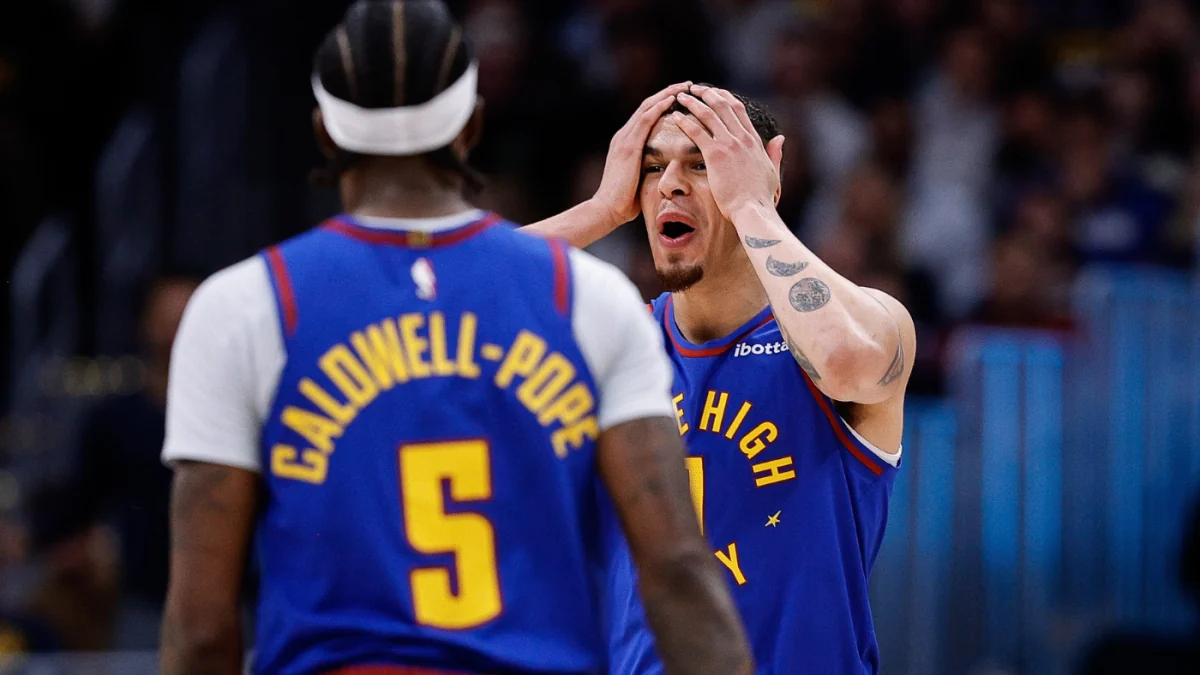
Denver's July 2026 decision on Spencer Jones shows both sides. Matching the restricted-free-agent offer preserved a young rotation player after his playoff contribution, while reporting put the projected tax increase from $36 million to $68 million and moved the Nuggets into second-apron territory. The contract decision was also a flexibility decision. Denver could value the player enough to accept the restrictions and later seek another way below.
The 2026 champion Knicks faced a similar strategic debate around retaining a complete title roster. A proven contender has the best argument for accepting short-term pain: championship odds are scarce, continuity has value, and replacing a trusted playoff contributor with a minimum signing can weaken the team. Yet staying above for repeated seasons risks turning a current bet into lost trade tools and a damaged future pick.
Reason to stay expensive
The current core has credible title equity, the player is hard to replace, and one apron season does not force the later pick-position penalty.
Reason to move below
The roster needs a trade path more than continuity, repeater cost is compounding, or the multi-season pick clock makes another year too damaging.
The schedule matters to that choice. A front office may wait through early games to measure health, lineup performance, and the standings before paying to shed salary near the deadline. Fans tracking the 2026-27 NBA schedule should read an apparent cost-cutting trade in this wider frame. Moving one contract can lower the bill and reopen the legal route to the next basketball move.
Sign in with Google to join the discussion.