How we rank Warriors greatness across eras
Stephen Curry leads our ranking of the greatest Warriors players because his case combines an exceptional peak, sustained franchise leadership and championship success. The more interesting arguments begin behind him: how much should Wilt Chamberlain's individual dominance count against a longer career, or Kevin Durant's two title runs against the years contributed by Klay Thompson and Draymond Green?
This is an editorial ranking of what players contributed as Warriors, not a ranking of their entire basketball careers. Chamberlain's championships with Philadelphia's 76ers and the Lakers do not become Warriors achievements. Durant's Oklahoma City MVP does not enter his Warriors résumé. Coaching, broadcasting and executive work also sit outside the playing-career comparison.
The franchise's Philadelphia years count. The Warriors began in Philadelphia in 1946, moved to San Francisco in 1962 and adopted the Golden State name in 1971. Leaving the earlier players out would turn an all-time franchise list into a California-only list without saying so. Paul Arizin and Neil Johnston belong in the discussion even if their uniforms look unfamiliar to fans who arrived during the modern dynasty.
We weigh four things: the level a player reached, how long he delivered for this franchise, his postseason contribution and the role he played in making his teams work. There is no pretend mathematical score. A championship matters, but a supporting player's ring is not automatically worth more than an elite season on a weaker roster. Team context explains both opportunities and limitations.
Era comparisons also need restraint. The pace, rules, spacing and statistical record of the 1950s differ sharply from modern basketball. Raw scoring and rebounding totals cannot settle every argument, and older defensive value is not fully captured by modern box-score categories. The order below is a defensible preference, not an official NBA ballot. Historical achievements are evaluated through the information checked on October 13, 2026, without projecting future titles or awards.
1. Stephen Curry: the franchise standard
Curry's strongest argument is that he clears several different tests at once. He won consecutive regular-season MVP awards in 2015 and 2016, became the first unanimous winner in 2016 and was central to the Warriors' championships in 2015, 2017, 2018 and 2022. The 2022 Finals MVP added the series award that had previously been missing from that résumé.
The NBA's 2016 MVP announcement captures his remarkable regular-season peak: 30.1 points per game and 402 made three-pointers during Golden State's 73-win season. Those numbers matter, but they do not fully explain the offense. His shooting range makes defenders confront actions farther from the basket, while his movement after giving up the ball prevents a possession from ending with the first pass.
That combination changes the jobs available to everyone else. A screener can become a passer against an overloaded defense. A cutter can benefit from a defender watching Curry instead of the lane. These advantages are not guaranteed baskets, and Curry did not build the dynasty alone, but his presence gave the Warriors a repeatable way to stress an opponent's priorities.
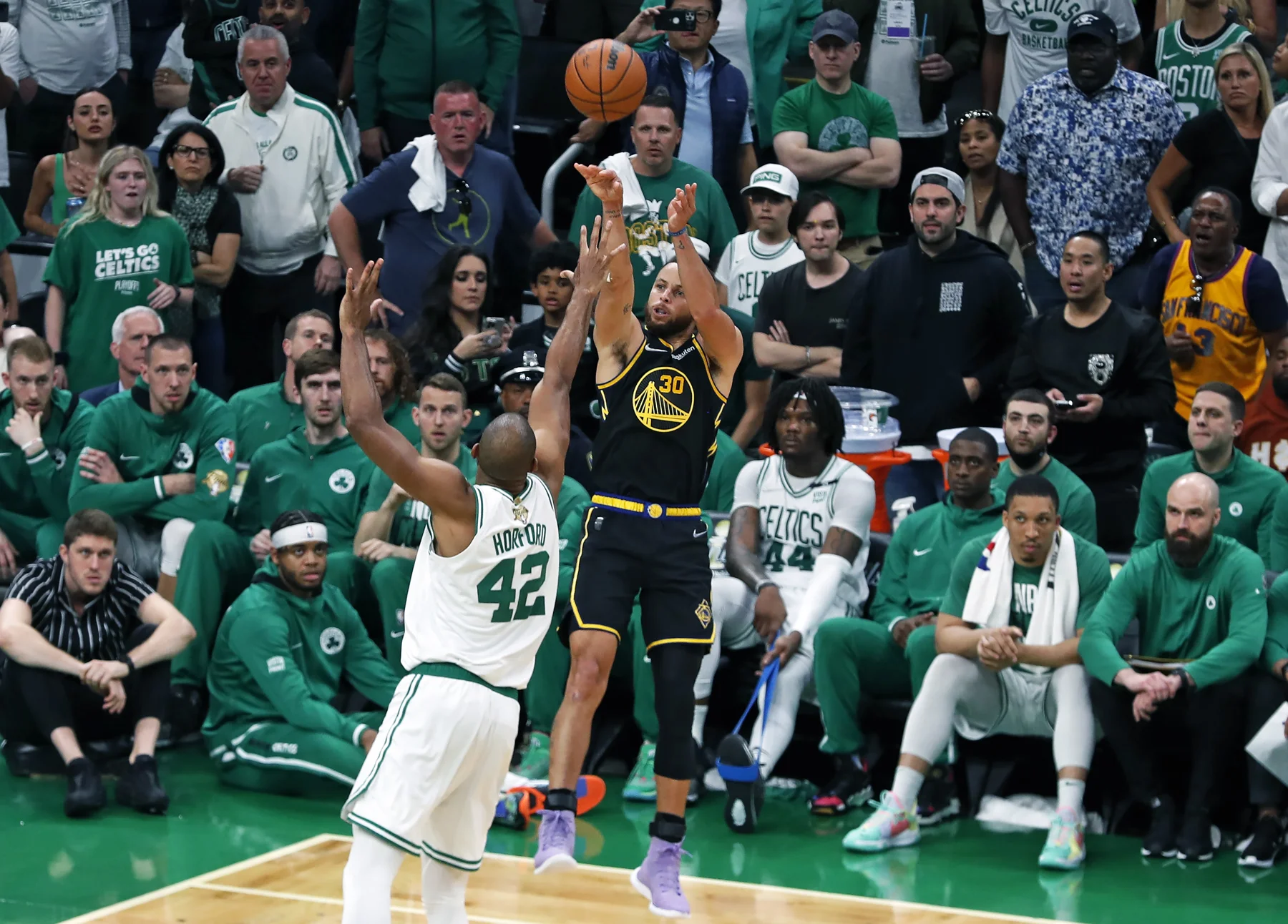
The 2022 Finals supplied a different kind of evidence from the overwhelming Durant-era teams. Curry scored 43 in Game 4 at Boston with Golden State trailing the series 2-1, helping level it before the Warriors eventually won the championship. That performance belongs in the ranking because of the situation as well as the total: it kept a difficult series from becoming a 3-1 deficit.
A franchise ranking rewards both the spectacular season and the ability to remain the team's organizing offensive force across changing teammates. Curry has the strongest combined case. Fans interested in the distinction between a historic regular season and the championship that did not follow can revisit our Warriors 73-9 season guide; the 2016 Finals loss is part of his story, not something an all-time list needs to hide.
2. Wilt Chamberlain: the most overwhelming individual peak
Chamberlain's Warriors years contain achievements that remain difficult to comprehend: the 100-point game against New York on March 2, 1962, a 50.4-point scoring average in 1961-62 and an MVP award as a rookie in 1959-60. These are Warriors accomplishments, belonging to the Philadelphia and San Francisco chapters of the franchise rather than to his later teams.
He also helped San Francisco reach the 1964 Finals, where Boston won in five games. That matters when assessing a résumé sometimes reduced to enormous regular-season totals. Chamberlain's teams did reach the championship series, but he did not win a title as a Warrior. His later championships cannot be imported to solve that limitation in a franchise-only ranking.
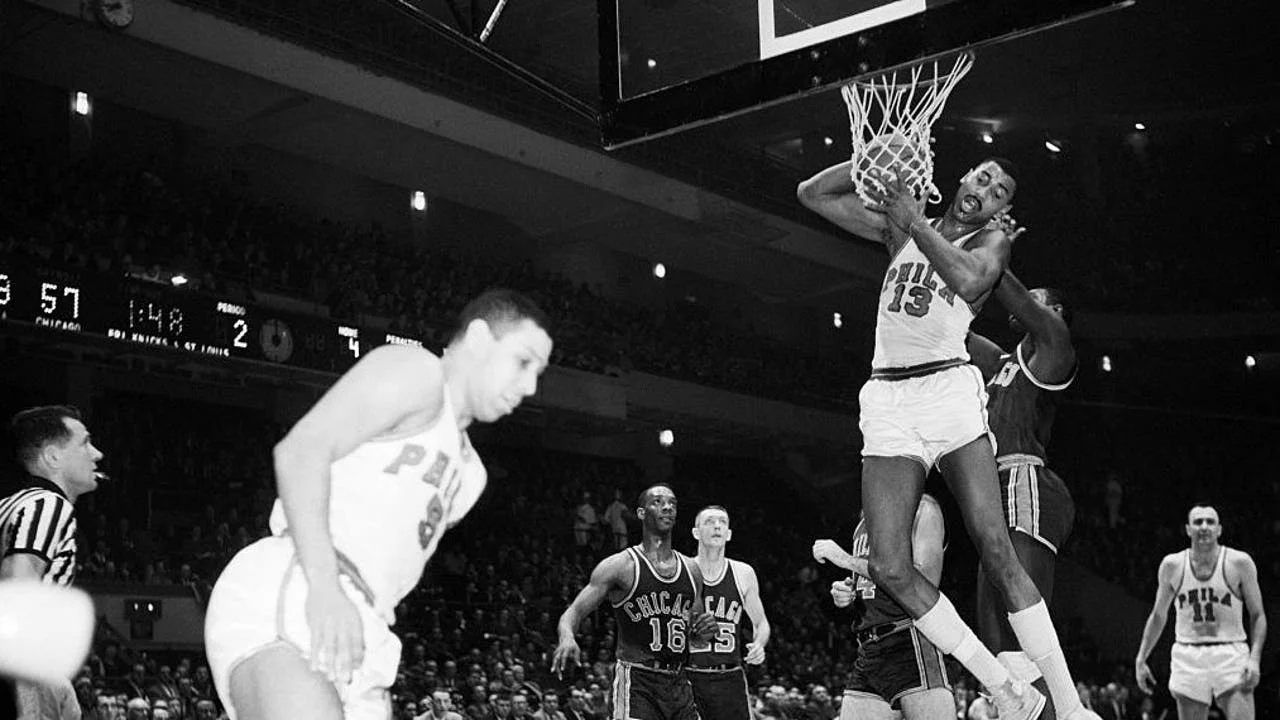
The statistical environment needs context. Fast games and heavy playing time helped create totals unlike those seen in most modern seasons. That observation does not make the dominance ordinary: he was extraordinary against the opponents and conditions he actually faced. It simply prevents a shortcut in which a points-per-game comparison alone supposedly proves how a 1962 player would perform in a modern offense.
Our second-place choice gives his peak substantial weight while preserving the distinction between peak and cumulative team impact. A fan who values the highest individual level above everything else could put Chamberlain first. A fan who requires a championship led with this franchise could move Barry ahead of him. Both positions need an explicit criterion, rather than a change of standards depending on which player is being discussed.
Curry stays ahead here because the combination of longevity, offensive identity and championship leadership is stronger under our chosen question. Chamberlain's place is still secure: no Warriors history is complete without the player whose physical and scoring dominance made opponents rethink how to handle the center position.
3. Rick Barry: the centerpiece of the 1975 champions
Barry owns the clearest championship-leadership argument outside Curry among these Warriors stars. He was Finals MVP when Golden State swept Washington in 1975, ending the franchise's title wait since 1956. The achievement was larger than the famous underhand free throw: he was the scoring and playmaking centerpiece of a champion.
His Warriors story also includes an earlier scoring peak and a trip to the 1967 Finals with San Francisco. The years between his two Warriors stints complicate the career narrative, but the comparison here remains straightforward. His ABA production belongs to his broader basketball legacy; it does not add seasons to his Warriors record.
The useful way to watch Barry is as a wing who could threaten a defense with both the shot and the pass. A scorer who recognizes the second defender can turn attention into opportunities for teammates. That distinction matters in a historical ranking: a high point total tells us who finished possessions, while the passing decisions help explain how an offense continued to function when opponents loaded up.
At the same time, the 1975 championship should not become a story in which one player did everything. Al Attles coached a team that needed contributions across its rotation, and a four-game Finals sweep does not mean every game was comfortable. Barry's status grows from being the leading player within that successful team, not from erasing the teammates and coaching that made the title possible.
He sits behind Chamberlain because this ranking gives substantial weight to an extraordinary individual peak as well as winning. Move championship leadership higher in your criteria and Barry has a strong case for second. Place greater emphasis on the length of the modern dynasty and Green or Thompson becomes a more serious challenger. Third is our balance between those arguments, supported by a Warriors career that includes both elite creation and the franchise's defining title before Curry's era.
The dynasty pillars: Green, Thompson and Durant
These three placements are the list's closest modern comparison. Durant reached the highest individual scoring level of the group. Green and Thompson contributed to the championship core for much longer. Our order rewards the sustained work of building and maintaining the Warriors' identity, while still giving Durant's exceptional three-season stay a prominent place.
4. Draymond Green: the defensive organizer
Green's 2017 Defensive Player of the Year award supplies a clear individual marker for a contribution that scoring lists undersell. His role has included directing teammates, switching assignments, helping near the rim and making the next pass after Curry draws extra attention. The value is not simply being versatile; it is recognizing which responsibility matters on the current possession.
That made him central to lineups that could play smaller without surrendering every defensive advantage. On offense, his passing could keep the possession moving when opponents tried to trap the primary scorer. We place him fourth because that combination supported multiple versions of the title team. His limitations as a scorer and costly lapses in discipline remain part of the evaluation; the ranking does not require pretending his influence was always positive.
5. Klay Thompson: shooting that changed the floor
Thompson's 41 points and 11 three-pointers in Game 6 of the 2016 Western Conference finals are an obvious landmark. They also illustrate why a defense could not spend all its attention on Curry. Thompson could change a game without needing to control possession after possession with the dribble, giving the Warriors another major scoring threat within the same offensive structure.
His place also rests on the years of work between the memorable shooting eruptions: perimeter defense, off-ball movement and championship continuity. Returning to win again in 2022 after major injuries strengthened the larger franchise story. Green edges him here because we give defensive organization and connecting offense slightly more weight; a voter who favors shooting and wing scoring could reasonably reverse them.
6. Kevin Durant: a short stay with an extraordinary ceiling
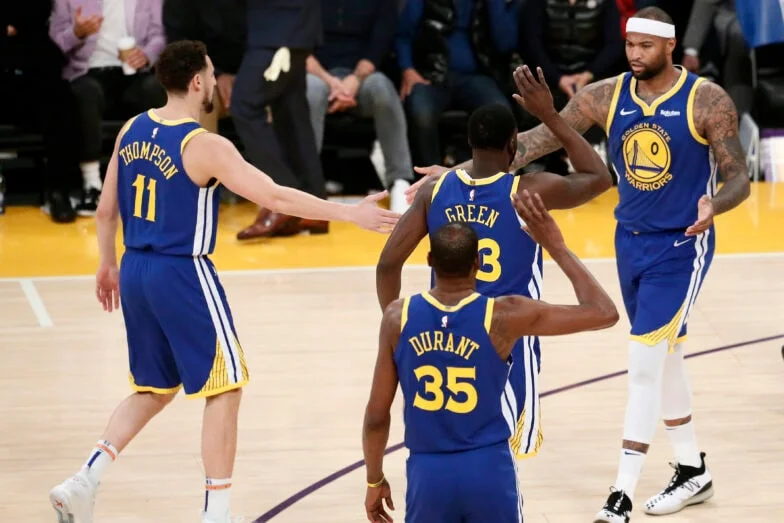
Durant won championships and Finals MVP awards with Golden State in 2017 and 2018. His arrival added a scorer who could create a quality attempt when an opponent disrupted the first action, while also contributing size and defensive versatility. The 2017 Warriors finished the postseason 16-1, a concise indicator of how difficult that team was to beat.
Sixth is not a claim that five Warriors were more talented basketball players. It reflects the shorter tenure in a franchise-contribution ranking. Put the emphasis on the best player for a single playoff series and Durant moves sharply upward. Under this list's broader question, the longer foundational contributions of Green and Thompson narrowly keep them ahead.
The earlier foundations: Arizin, Thurmond, Mullin and Johnston
7. Paul Arizin: Philadelphia's scoring cornerstone
Arizin combines a championship, sustained recognition and an important place in the development of perimeter scoring. The Basketball Hall of Fame records scoring titles in 1952 and 1957, ten All-Star appearances and leadership of Philadelphia's 1956 champions. Those are substantial credentials, not a token place reserved for someone from an older era.
His jump shooting helped distinguish him in a league whose offensive spacing and shot selection looked very different from today's. The fair comparison is with his own contemporaries before considering how his skill might translate. Seventh reflects the depth above him, especially the modern dynasty's repeated title runs; a ranking that places greater weight on sustained individual standing within an era could move him higher.
8. Nate Thurmond: the standard for interior defense
Thurmond's seven All-Star selections and defensive reputation make him essential to the Warriors story. He supplied rebounding and interior resistance during a period when the center matchup shaped much of a team's identity. Evaluating him only by points would miss the reason opponents had to account for him.
Older defensive records require care: a missing modern statistic does not mean the skill was absent. We favor the documented role and contemporary recognition over an invented all-era defensive number. Thurmond lands behind Arizin because the latter's scoring standing and championship role narrowly win this comparison. Fans who prioritize defensive anchoring have a strong reason to reverse those two places.
9. Chris Mullin: the face of a different Warriors era
Mullin's left-handed scoring belongs near the center of any account of the Warriors before the Curry dynasty. He earned All-NBA First Team honors in 1991-92 and became a defining player of the Run TMC era alongside Tim Hardaway and Mitch Richmond. His value was not dependent on looking like the most explosive athlete on the floor.
Footwork, timing and shooting let him punish defensive mistakes and operate within an attack that valued skill and movement. His longer Warriors contribution earns him this place even without a championship here. Ninth does not reduce that era to an unsuccessful prelude: it recognizes a different kind of franchise importance, while acknowledging that the players above him generally have stronger peaks, title leadership or defensive cases.
10. Neil Johnston: a champion too easily overlooked
Johnston won three consecutive scoring titles in 1953, 1954 and 1955 and was part of Philadelphia's 1956 championship team. The Hall of Fame's profile also records a rebounding title and describes the hook shot that made him such a productive interior scorer. His résumé is far stronger than his visibility in modern highlight culture suggests.
His place illustrates why this list includes the whole franchise rather than only familiar television eras. Dominating his contemporaries for several seasons deserves recognition even when little footage circulates today. The shorter career and the difficulty of comparing early-league conditions keep him tenth in our order. They do not erase his central role in a Warriors championship or justify replacing evidence with name recognition.
How the order changes when you change the question
A top ten necessarily leaves out players with strong cases. Andre Iguodala's 2015 Finals MVP and work within the championship lineups make him a serious candidate. Joe Fulks belongs in any account of the original Philadelphia Warriors, and Tim Hardaway helped define Run TMC. Their omission from these ten positions reflects close choices about the criteria, not a claim that their contributions were minor.
Change the question to “Which five would you put on the floor together?” and the answer should change. A functional lineup needs complementary defense, shooting, ball handling and size. It is not required to select the first five names from a franchise ranking. Likewise, choosing one player for a single postseason series puts more weight on peak performance than on how many seasons someone played here.
The most useful disagreements name the tradeoff. Durant above Thompson means prioritizing extraordinary short-term production over a longer championship partnership. Thurmond above Arizin gives interior defense more weight against scoring and title leadership. Barry above Chamberlain favors leading this franchise to a championship over the most astonishing individual statistical peak. Each argument can be made without pretending the other player's résumé disappears.
When revisiting the list, begin with the period you know least. Watch full possessions where footage exists, read the historical context and separate a player's Warriors years from his entire career. Highlights can show a great shot or block, but they rarely explain the repeated positioning and decisions that made a player valuable over a season.
Curry remains our first choice because he combines the strengths of several different arguments. The rest of the ranking traces a franchise with more than one identity: Philadelphia champions, dominant centers, Barry's title team, Mullin's skilled offense and the modern dynasty. For the next chapter, use the NBA team schedules to follow Golden State's games, while keeping the historical standard grounded in what each player actually accomplished.
Sign in with Google to join the discussion.