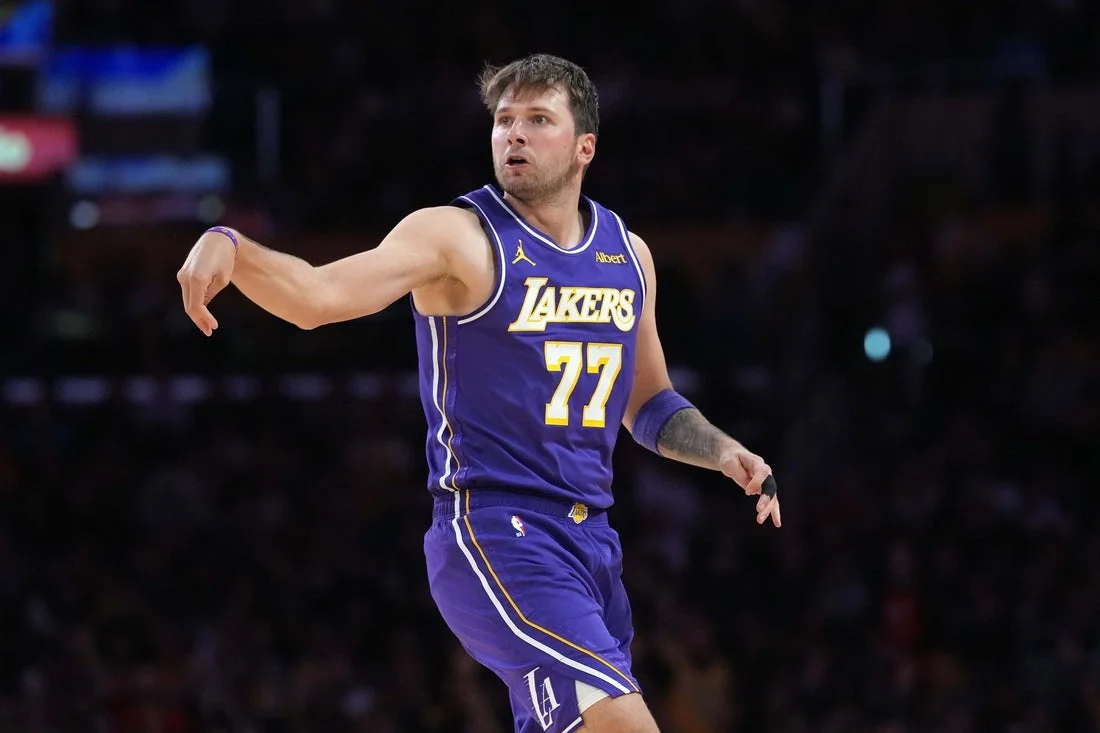
What the Lakers reported about Doncic's October 28 absence
Luka Doncic missed the Lakers' October 28 visit to the Clippers with back tightness. The date attracted attention because it was the second night of a back-to-back. Those facts explain why the absence became a discussion about rest, but they do not establish that a healthy player was deliberately withheld in violation of NBA policy.
The Lakers' injury report, covered by Silver Screen and Roll's Jacob Rude, ruled Doncic out after the previous night's game against Portland. JJ Redick subsequently described morning tightness for Doncic in comments reported by BasketNews. The available information supports an absence with a reported physical reason. It does not provide a more detailed public diagnosis, and this October 29 assessment does not invent one.
The second night supplies context, not a diagnosis
A consecutive-night schedule naturally raises questions about recovery. It can affect how a team evaluates a player's condition and how much flexibility it has between contests. Yet a schedule cannot tell a viewer whether a symptom is genuine, how it affects a particular movement or what a medical assessment found. Calling every second-night absence rest discards the very information needed to distinguish different situations.
The reverse shortcut is also unhelpful. A physical reason on a report should not be treated as a public announcement that the league has investigated and approved every aspect of the decision. Reporting a player's condition, deciding whether he should play and applying the participation policy are related processes with different purposes. Understanding those differences makes the criticism more precise.
The Lakers won the game 103-87, as the AP recap carried by CBS Los Angeles records. Winning does not validate a medical decision, just as losing would not prove that Doncic should have played. For a team adapting its offense, the useful basketball question is how the available guards create good possessions. For the policy discussion, the useful question is what evidence exists about the absence. A final score answers neither question by itself, however tempting it may be to turn the result into a verdict on everything that preceded it.
The participation policy restricts healthy rest and allows approved absences
The NBA's official policy announcement links the full participation policy, introduced for 2023-24. Its central distinction remains essential here: restrictions on withholding healthy stars operate alongside approved reasons for missing games. The policy is not a command that an injured player must appear because a matchup has commercial importance.
Who counts as a star under this policy
The formal category covers players selected to an All-NBA or All-Star team in any of the previous three seasons; after the All-Star Game, that season's All-Stars are added. It is not a fan vote on whose absence feels most disappointing. A well-known starter and a star as defined by the policy are therefore not automatically the same category.
That distinction helps when comparing two unrelated absences. A supporter might reasonably feel that losing a favorite role player damages the evening as much as losing a more decorated opponent. The policy can still treat the cases differently. Its defined coverage is an enforcement choice, while the fan's disappointment reflects a personal reason for attending. Neither becomes clearer by pretending they use the same definition.
National games and back-to-backs do not erase injury exceptions
The published policy emphasizes national television and tournament availability, limits multiple healthy-star absences and regulates approved back-to-back restrictions. Those restrictions have conditions; the calendar alone grants no automatic permission. Bona fide medical circumstances remain relevant to the league's review.
Apply that distinction to Doncic carefully. His absence occurred on consecutive nights, but the public reason was back tightness. It would be a leap to announce that the Lakers invoked a particular pre-approved restriction, because the report does not establish that. It would be another leap to call the absence prohibited healthy rest while dismissing the reported physical condition without evidence. The appropriate question is which reason and supporting information the team supplied, not which shorthand sounds most familiar.
For example, an announced plan to rest a healthy player weeks in advance raises a different issue from a new symptom reported on game day. The two can produce the same empty lineup slot while requiring different evidence. A useful policy discussion keeps that difference visible, then looks for an actual league finding before assigning a penalty. It does not turn a television designation, a tight schedule or an unsatisfying public explanation into a verdict on its own.
Two quieter provisions show why this is broader than a slogan about playing every night. The official announcement calls for a balance in one-game home and road absences and says a healthy player who is resting should be present and visible to fans. Those provisions address how an absence is managed as well as whether it occurs. They do not make a visible player automatically healthy enough to participate, or turn sitting courtside into a substitute for the game's medical assessment.
The national-window restriction also has a specific back-to-back detail. Under the published text, an approved back-to-back allowance ordinarily does not cover missing the national television or tournament game when the other game lacks that designation; the text addresses the case where both games qualify. That is a condition on that particular allowance, rather than a statement that genuine injuries cease to matter on television.
For a fan, this explains why a generic claim that a team can always choose either night is unreliable. The reason for the absence and the type of game both matter. It also explains why a photograph of Doncic near teammates would not resolve the medical issue. Being able to attend, being able to warm up and being available for competitive minutes are different claims. A useful challenge to the team's explanation should identify the claim actually in dispute, rather than treating every image or calendar pattern as equivalent proof.
An injury report and an NBA ruling answer different questions
The 2026-27 injury-report framework requires teams to disclose participation information and a reason when availability may be affected. It is designed to tell the public who may play. That is useful information, but it is not the same document as a league decision applying the participation policy to medical information and the surrounding circumstances.
A short phrase such as back tightness leaves many questions unanswered. It does not publicly describe an examination, reproduce treatment notes or show how an individual responds to movement. That lack of detail may frustrate fans, but it is not affirmative evidence that the report is false. It would be equally inaccurate to argue that typing an injury reason automatically prevents the NBA from reviewing the decision. Public disclosure and policy compliance remain separate obligations.
There is a recent example of the distinction in actual enforcement. In its February 12, 2026 announcement, the league fined Indiana $100,000 under the participation policy after an investigation including independent medical review. The NBA said Pascal Siakam and two other starters could have participated under its standard, including through reduced minutes, or could have been held out of different games in a way that better supported compliance. That was a documented finding about a particular case.
That same announcement treated Utah's separate roster-management conduct under a different basis. Combining the two penalties into one generic rule about any absent star would lose a consequential distinction. So would carrying Indiana's finding over to Los Angeles without the equivalent investigation and evidence. Similar-looking lineup absences need not have identical causes, approved circumstances or outcomes.
No NBA finding that Doncic's October 28 absence violated this policy was identified in the material reviewed for this article. That is a limit on what can responsibly be asserted as of October 29, not a prediction about every future review. The clearest language is therefore also the most useful: Doncic was reported out with back tightness on the second night of a back-to-back. A claim about fraud, an announced fine or a formal league approval would require additional evidence. Fans can question the transparency of the explanation while keeping that evidentiary line intact.
Why fans are frustrated, and what a ticket actually promises
The frustration has an understandable source. A fan may choose a single game because Doncic is visiting, arrange time away from work and pay for travel that costs more than the seat itself. The emotional purchase is an opportunity to see a particular player. The event on the ticket is still a scheduled game between teams, with availability that can change. That gap between expectation and the purchase terms is where much of the argument begins.
Check availability at the right point in the buying decision
If seeing Doncic is the main purpose, the most useful information check comes before making the least reversible purchase. For a local fan with flexible plans, that may mean waiting for a game-day report before buying a seat. For someone traveling, it may mean checking recent participation, the back-to-back context and the flexibility of transport and accommodation before committing to the whole trip. Those choices carry different price and seat-selection tradeoffs; waiting is not automatically cheaper.
Use a dated report for the actual game. An encouraging preseason interview, a clean report for the first night and a social post from the previous afternoon answer different questions. Confirm the date, opponent and update time, especially when information crosses time zones. The games-today page helps identify the event, while the injury report supplies the separate availability information.
Even a late check cannot remove every uncertainty. A symptom can develop after the previous game or during preparation. Treat a report as the best available information at that time, rather than a guarantee that the final lineup cannot change. That is a practical purchasing distinction, not a reason supporters should accept vague communication without criticism.
A missing player does not establish an automatic refund
Ticketmaster's standard purchase policy generally does not provide a refund simply because a participant changes or cancels. The Clippers' 2026-27 ticket terms also describe final sales subject to stated exceptions and applicable law. Those terms do not create a general automatic refund whenever an individual player misses a game.
The useful next step for an actual purchaser is to identify the seller and the terms attached to that order. A special membership benefit, an organizer-authorized exception and a standard single-game resale purchase may have different conditions. Keep the receipt and any specific promise, then ask that seller what remedy the purchase actually includes. A league fine, if one were imposed, would be a separate disciplinary action; it would not by itself establish a payment to every disappointed ticket holder.
Our NBA ticket buying guide covers the wider purchase process. For this case, the narrower lesson is to make the availability check and the refund check separately. One concerns who may play; the other concerns the agreement under which the seat was bought.
What would change the answer about Doncic's next game
The Lakers' next scheduled game is at Golden State on Friday, as the Los Angeles Times' postgame account carried by Yahoo noted. That supplies the next opponent, not Doncic's availability. A schedule page and an injury report serve different purposes, and combining them into a guessed return date creates information neither page actually provides.
Follow a new report instead of treating precautionary as a timetable
Descriptions such as cautious or precautionary explain the approach attributed to the team. They do not tell fans how symptoms will respond overnight, whether a player will participate in preparation or how a staff will evaluate him before the next game. A fresh status update is therefore more useful than repeatedly interpreting the same adjective. If the team gives a specific update about availability or workload, that new statement should replace assumptions drawn from the earlier absence.
For someone deciding whether to attend the Golden State game, the immediate evidence to seek is a report naming that matchup, followed by any later team change. For someone discussing policy enforcement, the relevant new evidence would instead be an NBA announcement about a review or finding. A player returning promptly would update the availability story without retroactively proving that the earlier symptom was fabricated. A player remaining out would not automatically prove that every aspect of the team's decision had received league approval.
The basketball evaluation is a third track. If Doncic returns, watch how the Lakers distribute initiation and how the substitution pattern develops. If he remains unavailable, the available guards still need an organized route into offense, with a plan for possessions that do not produce an early advantage. The Clippers result shows that the team won one game without him; it does not establish that his contribution is replaceable across a season or that one rotation should work against every opponent.
Use the team schedule directory to identify upcoming dates and the injury-report guide to interpret the latest status. Keep the reporting date visible when sharing an update, particularly when a Wednesday game in California appears under a Thursday date elsewhere.
As of this October 29 review, the supported answer is straightforward: Doncic missed the Clippers game with reported back tightness during a back-to-back. The public record examined here does not establish a participation-policy violation or a guaranteed return date. That leaves room for legitimate questions about communication and the fan experience while requiring the next claim to rest on the next actual piece of evidence.
Sign in with Google to join the discussion.