The quick way to spot a 2026 NBA Cup court
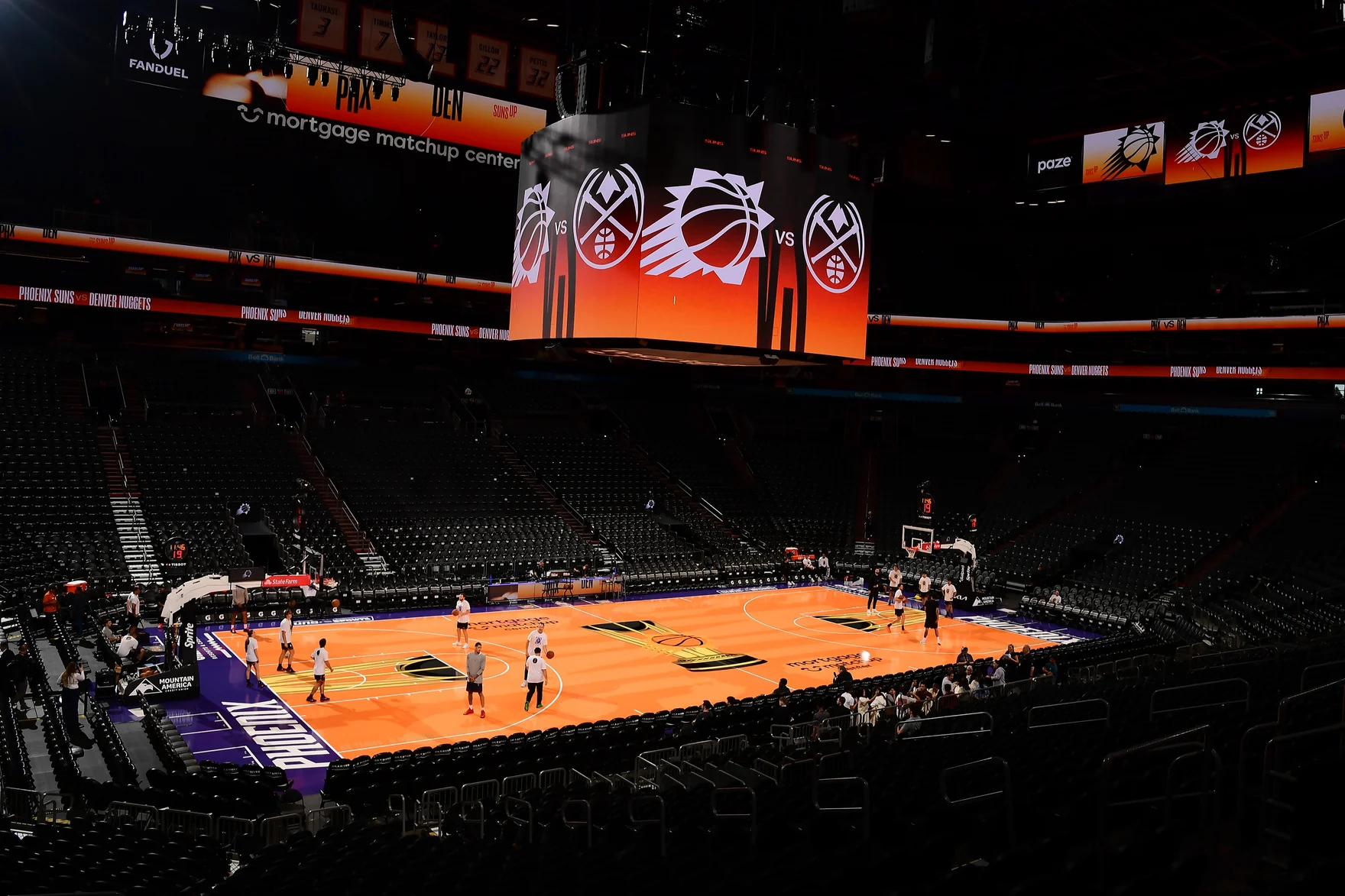
The 2026 NBA Cup gives every team a fully painted home court for the tournament. Start with the trophy at center court, where the host team’s primary logo sits over the Cup graphic. Then look for the oversized team lettering repeated at opposite ends of the floor. A second trophy mark in each lane makes the surface identifiable even when a tight camera angle cuts out half court. Those clues work on a league-wide opening night and on a single elimination game in December.
The typography is the quickest way to place a clip in the right year. In the 2026 designs, the large lettering is woven into the floor around the half-court graphics and takes its style from Nike’s basketball warmup collection. The lane trophies carry over as a familiar Cup cue. Near the corner three, the league added a small printed line about the field narrowing from 30 teams to eight and then one. That last detail may disappear on a phone screen. The repeated lettering takes up enough space to show up across possessions.
Host identity explains why the visual experience changed in the middle of the Oct. 30 opening doubleheader. New York visited Philadelphia, so viewers saw the Sixers’ design. The Lakers visited Golden State later that night, so the second arena carried the Warriors’ markings. The two visiting teams each have a Cup design of their own for dates they host. When you jump into a game after tipoff, look for the floor logo first, then look at the scoreboard to see who is playing.
The regular NBA lines still give you your bearings. Find the arc, baseline and free-throw lane, then look at the background underneath them. Some teams spread a pale field across the whole playing area, and some use saturated tones. A closer picture from the arena often shows details that wash together on a live feed. Color is a clue. A team crest paired with a Cup trophy and a matching game on the schedule is a much stronger identification.
Eastern Conference court designs
These are the 15 Eastern designs, grouped the same way the NBA groups its Cup fixtures. The first color described is the large field inside the court. The second is the surrounding strip, sometimes visible on just one side in a live feed. Those two areas make it easier to separate designs that use the same primary color. For a closer look at the lettering and lane art, the NBA’s official court gallery shows each design from directly above.
East Group A
The Detroit Pistons surround their deep blue floor with red and put the round Pistons badge on the trophy. The Toronto Raptors also use a red surround, but the floor itself reads gray and the roundel carries the claw marks. The Orlando Magic use a gray floor against a blue surround, with the star-trailing basketball on the Cup at midcourt. Check the outside color if a broadcast crops away the logo: that separates Orlando from Toronto.
The Milwaukee Bucks use deep green inside a light tan surround, with the deer head at the center. The Brooklyn Nets have a neutral gray field inside a near-charcoal surround and a black-and-white basketball carrying the letter B. Toronto, Orlando and Brooklyn show how much work the border can do when most of the visible floor is gray.
East Group B
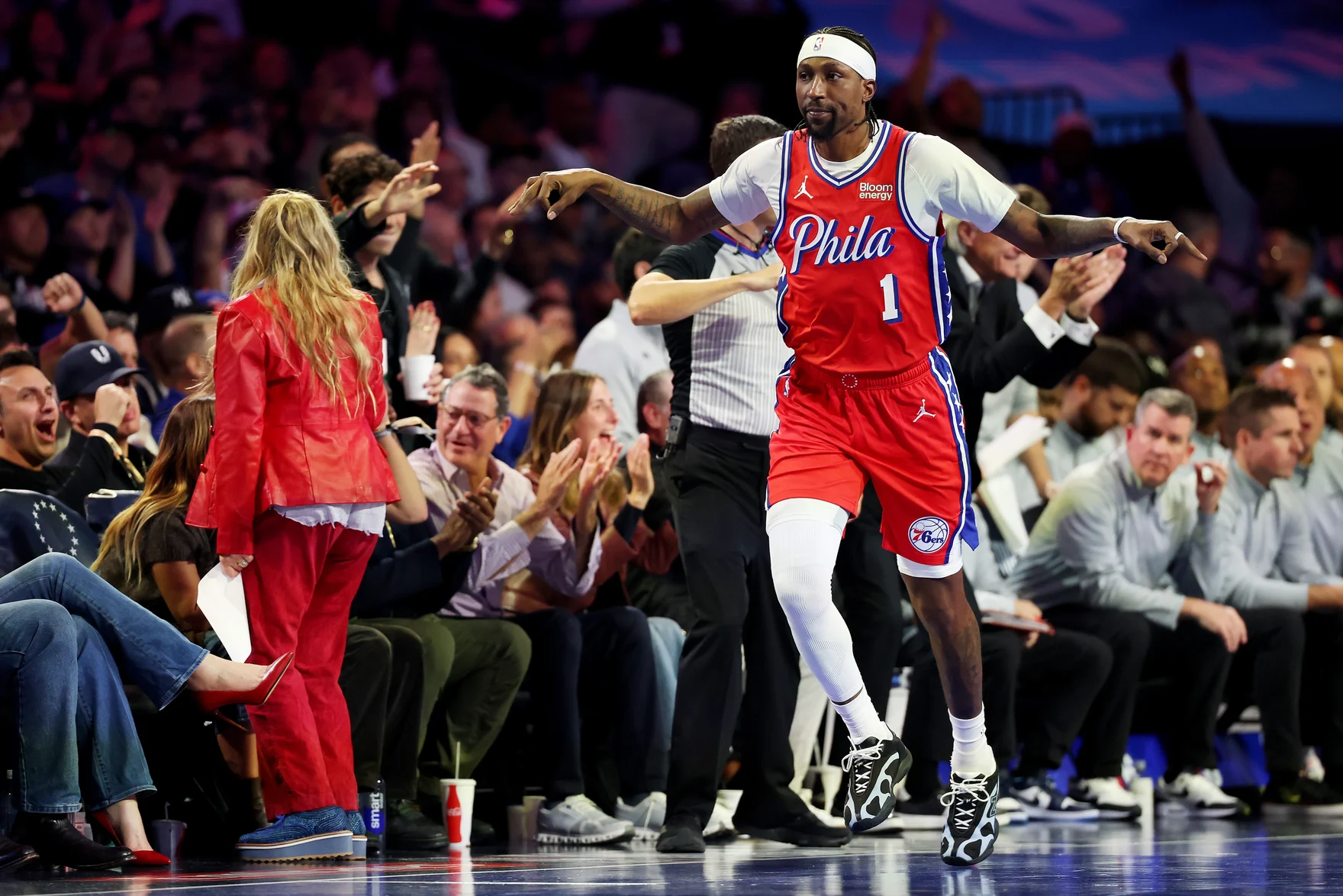
The New York Knicks set blue inside an orange frame, with the team's stacked crest across the trophy. The Cleveland Cavaliers use wine and gold, with their curved C at midcourt. The Philadelphia 76ers put a blue field against a darker blue frame and use the 76 mark. The Miami Heat go with a golden-orange playing area and dark surround, with the flaming ball and hoop at the center. The Indiana Pacers use dark blue and bright yellow, with the basketball P logo and a bold phrase along the sideline.
Two national Cup broadcasts featuring New York illustrate what the group labels leave out. On Oct. 30 at Philadelphia, an opening-night viewer saw the Sixers’ blue setup. On Nov. 13 at Indiana, viewers saw Indiana’s yellow-edged floor. The group stayed the same across those dates. The hosts and the surroundings changed.
East Group C
The Boston Celtics combine green, a gray surround with a parquet pattern, and a shamrock in a dark circle at center. The Atlanta Hawks are easy to pick out by the red field and broad yellow edge, with a hawk profile at midcourt. The Charlotte Hornets move toward teal and gray, with the hornet over the Cup trophy.
The Chicago Bulls and Washington Wizards both put red inside gray. Chicago’s central bull head is the faster cue, while Washington uses the circular red, white and blue monument mark. The Wizards' surround also reads lighter than Chicago’s in the design drawings. Try the logo first on a small or dim screen, where two shades of gray may look identical.
Western Conference court designs
The West includes several floors with a gray playing surface and another cluster built around blues. A glimpse of the baseline often gives you more to work with than a still from the middle of the lane. The primary crest resolves the closest pairs.
West Group A
The Denver Nuggets put a wine-red playing area inside a yellow frame and use crossed pickaxes at center court. The Houston Rockets use brighter red with a charcoal surround and an angular Rockets shield. The Phoenix Suns use orange framed by a deep purple edge and add the sunburst basketball over the Cup.
The Dallas Mavericks go with strong blue inside a very dark surround and place the horse head at midcourt. The Utah Jazz pair their purple playing area with a lighter blue edge and a white musical note. Phoenix and Utah both bring purple into the design, but they give it different jobs. The orange field and the sunburst settle which of the two you’re looking at.
West Group B
The Oklahoma City Thunder put brighter blue around a deep blue interior, with their diagonal OKC crest at center. The Minnesota Timberwolves use a pale gray playing area and a blue edge, with the wolf in a roundel. The LA Clippers set a navy field inside a medium-blue surround and use the round compass-and-ship emblem. Look for the pale center to tell a Minnesota home game from a Clippers or Thunder home game in this group.
The New Orleans Pelicans also use a deep blue interior, but place it inside a tan-gold frame and use their spread-wing logo. The Memphis Grizzlies pair gray with deep navy and put the blue bear across the trophy. Check the sideline when Memphis and Minnesota look similar. Memphis has a repeated linear pattern in the outer strip, while the center logos offer a clear bear-versus-wolf cue.
West Group C
The San Antonio Spurs use charcoal and black with the spur motif at center. The Los Angeles Lakers use bright yellow with a near-black surround and the Lakers script over the trophy. The Portland Trail Blazers combine gray, a black surround and a red-and-white pinwheel. The Golden State Warriors put a light gray field inside blue with the bridge logo at center. The Sacramento Kings use gray inside purple, the crown shield and a checkerboard detail along the sideline. Golden State’s bridge settles the lookup when most of the visible playing area is gray. Sacramento, Portland and Golden State each use a different colored perimeter around that same broad family of floor tones.
Which rounds use the team courts?
The NBA designated the 30 team designs for group play, the quarterfinals and the semifinals. The first two knockout rounds use NBA team arenas in 2026. The championship has its own venue, which was set before group play began.
Group play and the home-team floor
Group play is spread over seven Cup nights, from Oct. 30 through Nov. 27. Each team plays all four members of its group once, with two games at home and two on the road. That gives every club two scheduled home group games for its design. A road game can have the same stakes for the group table while taking place on an entirely different floor.
The distinction matters when you are booking a game around the look of the court. Open the 2026 NBA Cup schedule and match the date, opponent and host. A fixture in the same arena on a different day can be an ordinary regular-season game. Once the group schedule ends, the original 82-game calendar also has slots filled in according to Cup results. Only designated Cup games in that stretch carry the tournament visuals.
Quarterfinals, semifinals and the Indianapolis final
The top two Cup seeds in each conference host the quarterfinals on Dec. 4 and 5. The highest seed in each conference draws its conference’s wild card. The higher remaining seed hosts the semifinal on Dec. 8 or 9. That home semifinal format is new for 2026. Cup seeding comes from the group phase and its tiebreakers, so use the tournament bracket to find the venue when two teams have similar overall records.
The final is set for Dec. 11 at Hinkle Fieldhouse, Butler University’s arena in Indianapolis. The announcement for the 30 team floors covers the rounds through the semifinals. For the title game, the confirmed information is the neutral venue and date. The two teams that get there will be playing on Butler’s campus. In the United States, Prime Video has all seven knockout games, so the next thing to check when a matchup is set is the arena in the listing.
How the floor and jerseys work together
The NBA designed each of the 30 painted surfaces around the host club’s Statement Edition uniform. The home jersey and main playing area can pull from very different parts of the same team’s palette. Look at Philadelphia. Its 2026 design puts blue across the playing area and a deeper blue outside the lines. The red Statement jerseys from the New York game stand out against that blue. Picking the floor from the brightest color on the home team's jersey would lead you in the opposite direction.
Visit NBA LockerVision’s game schedule if you want to identify the outfit alongside the floor. Pick the date and matchup to see the two assigned editions. The same team can wear several editions during a three-game homestand, and the visiting team in one game can be the host in the next. Once you confirm the uniform names, check the date-specific Cup label and host, then use the all-team floor designs to finish the match.
The oversized graphics are linked to a different piece of clothing. Nike described its Standard Issue line as gear for warmups, practice and travel. The league drew inspiration for the lettering from that collection’s game jacket. The letters are integrated into the surface color, so some of them become clearer from a high camera or pregame photograph. The full-size crest at midcourt serves the same purpose at a distance when the tone-on-tone letters merge into the floor.
A replay can be recognizable as a Cup game without giving away its year. In 2024 the design used concentric circles. Victor Solomon, who designed the 2025 courts, described that edition as a color gradient built around a five-by-five mosaic tied to five players and five teams per group. The 2026 floor can be picked out by its mirrored wordmarks and primary team icon at center. The trophy graphic crosses those years, which is why its presence tells you more about the competition than the season.
How to look up the court for a particular game
Start on the team schedule or the league’s Cup calendar. Find the opponent and check for the tournament label. For a game in the first three stages, read the venue and the home team together. On a schedule that uses the word “at,” the host comes second. Then find that team in the group list above. A ticket listing may lead with a star player or visiting team, so take the arena from the actual fixture. The central crest in a pregame image gives you a third check if there is any uncertainty.
The Nov. 25 ESPN tripleheader is an easy test. Miami visits Philadelphia at 5 p.m. ET in the first game, giving viewers the Sixers’ blue floor. Minnesota visits Oklahoma City at 7:30 p.m. ET, so the next broadcast moves to the Thunder’s dark blue design with the brighter edge. San Antonio visits Portland at 10 p.m. ET, switching the floor again to the Trail Blazers’ gray-and-black setup. One network carries all three. The court is tied to the host, regardless of whether you keep the same channel open all night.
Miami also offers a useful example of why a graphic-heavy court can be misleading. On Nov. 18 the Heat hosted Milwaukee on a special Vice City floor at Kaseya Center. That game had its own theme and placement on the regular-season schedule. For Miami’s next two Cup dates, Nov. 25 at Philadelphia and Nov. 27 at New York, the Heat are the visitors. If a clip shows the special Miami floor, the date and matchup will help place it before you even look for a Cup trophy.
For the December elimination games, start with the Cup schedule and check the host listed in the bracket once the matchup is set. If you’re watching from the United States, use the NBA TV schedule or the game listing to verify the time and broadcaster. For a replay, begin with the date and venue and work backward. You’ll know which court to expect before the camera reaches midcourt.
Sign in with Google to join the discussion.