A serious injury starts a medical process, not an automatic exception
An NBA disabled player exception can help an over-the-cap team acquire one replacement. It does not recreate the injured player's talent, cancel his salary or guarantee a move. For 2026-27, the useful question is therefore more specific than “How much money did the injury free up?” A front office needs medical approval, an eligible contract and a legal transaction before there is a player to discuss.
Under the current NBA–NBPA agreement, the medical test concerns the player's likely inability to play through the following June 15. An NBA-designated physician evaluates that question. A lengthy absence reported in October is not itself the league's decision. Neither a frightening replay nor an optimistic rehabilitation comment establishes the administrative result.
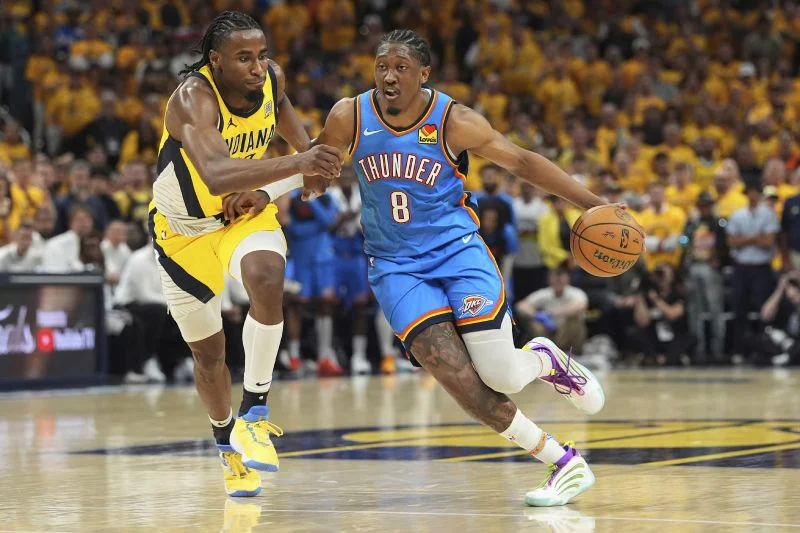
Oklahoma City's injuries explain the renewed interest. The October 27 injury update reported surgeries for Jalen Williams and Cason Wallace, with timetables pending. As of this guide's October 29 cutoff, we are not treating the Thunder as having an approved exception. The rules below explain a possible mechanism; they are not confirmation of an application, award or agreed acquisition.
That distinction changes how to read transaction coverage. “Can apply” describes access to a process. “Has been granted” identifies a completed approval. “Plans to use” describes a team's intention, while a completed signing or trade is another step again. A report can be accurate at one stage without answering the next. Fans comparing potential targets should first identify which of those stages has actually been reported.
The basketball urgency can be real before any exception exists. Coaches must distribute minutes immediately, whereas medical evaluation and the trade market operate on different clocks. A team can initially rely on its existing rotation without giving up the possibility of outside help. For availability language rather than transaction authority, use the separate NBA injury-report guide.
How the 2026-27 dollar limit is calculated
The base ceiling is the smaller of half the injured player's salary for that cap year and the non-taxpayer mid-level exception. The league's 2026-27 release sets that mid-level figure at $15.044 million. Start with that formula rather than a rounded social-media estimate.
Half the injured player's salary is only one side of the formula
Take a fictional injured player earning $20 million this season. Half is $10 million, below $15.044 million, so a granted exception's base amount would be $10 million. Now take a fictional $40 million salary: half is $20 million, but the lower figure is $15.044 million. Losing the more expensive player does not produce a $20 million replacement budget.
These examples describe this season's salary, not half the remaining value of a five-year contract. They also do not require the club to have an unused ordinary mid-level exception of the same size. The non-taxpayer mid-level supplies a numerical ceiling here; it does not make the two acquisition tools interchangeable. For a proposed transaction, contract details and any relevant bonuses still need review rather than a comparison of rounded headline salaries.
A trade or waiver claim has a separate $100,000 allowance
The agreement treats acquiring an existing contract differently from signing a new one: an assignment can have salary up to the base ceiling plus $100,000. Consequently, a hypothetical $10 million base produces a $10.1 million assignment limit. At the full 2026-27 base, that calculation becomes $15.144 million. It is inaccurate to say every acquired salary even one dollar above $15.044 million necessarily fails this test.
That narrow allowance is not another $100,000 to add to a free-agent offer. Nor does it make a much larger contract fit. A fictional player earning $16 million still exceeds the full assignment ceiling. Sending a draft pick would not change that salary comparison: a pick might influence the selling team's willingness, but it does not change the incoming contract's number. Separating bargaining assets from the legal salary limit eliminates a surprising amount of confusion before any mock trade is built.
Which players can actually be acquired?
There are three possible routes: a free-agent signing, a trade or a waiver claim. Each leads to a different marketplace. A free agent must agree to the offer. A trade requires another team to accept the return. A waiver claim follows the league's claim process. Owning an exception does not give a club priority over every other interested buyer or make another team's useful veteran available.
One replacement and a contract that ends this season
The contract term is a real filter. A new DPE signing covers one season; an acquired contract must have only one season remaining. The exception brings in one replacement, not several players sharing a pool. That narrow purpose appears in the league's CBA overview and the governing agreement.
Consider two fictional wings, each earning $9 million. One has an expiring contract. The other has another guaranteed season at the same salary. With a hypothetical $10 million DPE, the first passes the basic salary-and-term screen; the second fails the term screen despite being equally affordable this year. A future option season also requires scrutiny: “He might become a free agent” is not the same as a contract already having one season left.
A team also cannot stack a DPE with another exception or add outgoing salary to enlarge this exception's incoming ceiling. Imagine a $10 million DPE, a separate $5 million trade exception and a $14 million target. The two amounts are not a combined $15 million coupon. A transaction might be achievable through a different independently legal mechanism, but that would need its own analysis. The DPE does not become bigger because the proposal contains more moving parts.
These rules explain why a list of attractive names is less useful than a list of eligible contracts. First filter for salary and term; then ask about basketball fit, availability and acquisition cost. Expiring status does not make a seller indifferent. A contender may value that player's playoff minutes more than the draft compensation offered by an injured rival.
Why the injured salary and roster spot do not disappear
Approval provides a way to add salary over the cap; it does not subtract the injured contract. Think of a team's payroll as an existing obligation plus a possible new obligation. An exception permits a particular addition. It does not turn the previous obligation into a negative number, and the replacement's salary enters the relevant payroll calculations.
Roster capacity is another question. The NBA's roster provisions ordinarily allow 15 standard contracts, alongside the separate two-way structure. Moving an injured standard-contract player to the inactive list does not free one of those standard positions. A club already carrying 15 cannot simply count its approved DPE as position No. 16.
Consider a fictional team with 15 standard players and one long-term injury. It might have an exception large enough for a useful guard but no ordinary roster opening. A separate move would be needed to create capacity, unless another independently authorized roster exception applied. Waiving somebody is not costless just because it removes his name from that roster: guaranteed salary can remain an obligation. The basketball decision can therefore involve losing a developing player or depth at a different position.
A hardship roster exception addresses a different administrative problem and requires its own conditions and approval. It should not be treated as another name for the DPE. Likewise, the agreement's provisions for career-ending injury salary exclusion are a separate process. A season-long absence does not, by itself, establish a career-ending condition or authorize removal of the contract from team salary.
This separation is particularly useful when reading a report that an injured team has “room.” Room might mean an empty standard roster position, space below an apron, or a salary exception. Those are different resources. A workable signing needs the relevant pieces together. When a proposed move fails one test, pointing to success on a different test does not rescue it.
An exception does not erase the tax or a hard cap
Two clubs can hold identically sized exceptions and have very different practical spending power. One may have comfortable payroll flexibility; another may be constrained by a hard cap triggered earlier in the year. Both still need to consider the financial cost of the incoming player. An injury exception is not a tax exemption.
First separate the spending tool from an apron trigger
Using a DPE does not, by itself, mean using the ordinary non-taxpayer mid-level exception or automatically activating that tool's hard-cap consequence. But the DPE also does not override a hard cap already in force. Other elements of the proposed move can independently matter—for example, the restrictions involving a player waived during the regular season after carrying a salary above the non-taxpayer mid-level amount.
That is why “They are above the first apron” and “They are hard-capped at the first apron” should not be used interchangeably. An apron is a threshold with transaction consequences; a triggered hard cap is a ceiling the club must respect. Our 2026-27 salary-cap and apron guide explains the broader system. Here the key point is that a medical exception does not reset the team's earlier transaction history.
Test the actual transaction against the team's remaining room
Suppose a fictional hard-capped club has $3 million of genuine room below its applicable ceiling and a $10 million DPE. A move adding $5 million of relevant payroll fails the room test even though the contract fits the exception. If instead the club has $8 million of room, the same addition leaves $3 million before considering any other required adjustments. The exception's headline size is not the binding number in the first scenario.
Use the appropriate apron payroll, including the relevant incentives and adjustments, rather than assuming that every website's headline salary total is identical. Also leave room for the rest of the roster plan. A move that barely fits today may leave little flexibility for later injuries or another signing. For an owner, the total bill can include increased tax as well as salary; for a front office, the cost can include opportunities it cannot pursue later. Those are reasons to evaluate a transaction carefully, without pretending that a cautious decision proves the exception had no value.
Application, expiration and an early return change the timeline
An exception is a time-limited option. It cannot be saved for an attractive free agent the following summer. That makes the timing of approval and the availability of appropriate players part of its value. A legal tool acquired in October may still have little immediate use if every sensible target remains under a contract that fails the eligibility screen.
January 15 and March 10 answer different questions
The ordinary application window runs from July 1 through January 15 of the cap year, and the exception expires on the following March 10. For this season, those relevant later dates are January 15, 2027, and March 10, 2027. The first concerns requesting the tool; the second concerns using an approved one. Neither date is a substitute for the NBA's trade deadline or separate postseason eligibility provisions.
A return can end the opportunity sooner. If the injured player resumes playing before the team uses the exception, the unused DPE is extinguished. Trading that injured player before use also extinguishes it. If the club has already used the exception and the original player subsequently recovers, he may resume playing. The medical forecast that supported approval was not an order forcing a healthy player to sit out the rest of the season.
Imagine two fictional teams holding the same unused exception in February. Team A completes an eligible signing, then gets its injured player back. Team B gets its injured player back before signing anyone. Team A's completed acquisition is not retrospectively undone merely because recovery went better than expected; Team B no longer has an unused replacement tool to spend. The sequence matters, not just the date printed on an exception tracker.
For a fan following the calendar, keep the acquisition route beside the expiration date. A March free agent and a February trade target belong to different decision windows. The NBA signing-deadline guide covers the broader calendar, while the season schedule helps show how many games an eventual addition could actually influence.
What a useful replacement would mean on the floor
The phrase “replace a star” can create an impossible standard. A useful acquisition might replace one task: organizing a bench possession, defending the first screen or keeping a help defender occupied in the corner. Those are meaningful improvements even when the new player cannot reproduce the injured teammate's entire game. The salary exception measures transaction capacity, not basketball equivalence.
For the Thunder's situation, the first analytical question is which possessions become hardest to manage without the missing players. A ballhandler can reduce the burden of creating a shot after the initial action breaks down. A perimeter defender can help keep the team's big men out of repeated emergency rotations. A shooter can make the defense pay for overloading the remaining creator. One newcomer may solve one of those problems while leaving the others to existing teammates.
Evaluate the cost against the minutes actually improved. A veteran who raises the quality of 15 difficult minutes can be valuable, but trading away a rotation player elsewhere may merely relocate the weakness. An expiring contract can preserve next season's flexibility without being cheap to acquire today. Conversely, an appealing long-term fit might belong in an ordinary trade discussion because his contract cannot be absorbed through this exception.
When another report appears, ask for the missing fact rather than immediately naming the next target. Has the league granted the exception? Does the proposed player's salary and remaining term fit? Is there roster capacity? Does the entire transaction respect the club's applicable payroll restrictions? Only then does it make sense to debate the player's fit, price and likely minutes. A DPE can create a useful extra route, but an actual improvement still requires an available player and a sensible basketball decision.
Sign in with Google to join the discussion.