NBA Cup winners by year at a glance
Three teams have won the NBA Cup through the 2025-26 season: the Los Angeles Lakers, Milwaukee Bucks and New York Knicks. Each completed title game has produced a different champion and a different tournament MVP. The 2026 edition is scheduled to crown the fourth winner on December 11, but no team can be added to this record until the game is played.
| Tournament | Champion | Runner-up | Final score | Tournament MVP |
|---|---|---|---|---|
| 2023 · 2023-24 season | Los Angeles Lakers | Indiana Pacers | 123-109 | LeBron James |
| 2024 · 2024-25 season | Milwaukee Bucks | Oklahoma City Thunder | 97-81 | Giannis Antetokounmpo |
| 2025 · 2025-26 season | New York Knicks | San Antonio Spurs | 124-113 | Jalen Brunson |
| 2026 · 2026-27 season | TBD | TBD | TBD | TBD |
The tournament year follows the calendar year of the December championship, while the season label spans two years. Thus “the 2023 winner” and “the 2023-24 winner” both refer to the Lakers. This guide uses the shorter tournament year in headings and retains the season in the table to remove ambiguity.
2023 Los Angeles Lakers: the inaugural winners
The first NBA Cup final gave Los Angeles a useful test of identity. Indiana arrived with the tournament's most dangerous transition attack and an offense organized by Tyrese Haliburton, while the Lakers had built their run around size, rim pressure and defensive versatility. Los Angeles did not win the December 9, 2023 title game by matching the Pacers shot for shot from outside. It won 123-109 while making only 2 of 13 three-pointers because its best players repeatedly forced the game toward the paint.
That distinction matters when looking back at the first champion. A seven-game Cup run can be shaped by shooting variance, but the Lakers produced a repeatable advantage: LeBron James got the ball downhill, Anthony Davis occupied the rim at both ends, and larger perimeter defenders made Indiana work before it could reach its preferred early-clock actions. Los Angeles finished the event 7-0, giving the new competition an established star team and a clear first blueprint for surviving single-elimination basketball.
Anthony Davis controlled the championship game
Davis supplied the defining final performance: 41 points, 20 rebounds, five assists and four blocks on 16-of-24 shooting. Every one of his made field goals came in the paint. The Lakers outrebounded Indiana 55-32 and outscored the Pacers 86-44 inside, numbers that explain the result more clearly than either team's three-point total. Davis could finish over a switch, sprint into a deep seal before the defense was set, or clean up a possession after a teammate drew help.
The closing sequence made his control unmistakable. Indiana cut the lead to three with 6:11 remaining, threatening to turn the final into a one-possession sprint. Los Angeles answered with 13 consecutive points, and Davis scored 10 of them. That run was the game in miniature: when the Pacers created urgency, the Lakers slowed the possession enough to find their largest matchup advantage. Davis also deterred attempts at the other end, allowing Los Angeles's guards and wings to pressure higher without leaving an unprotected rim.
Why LeBron James won tournament MVP
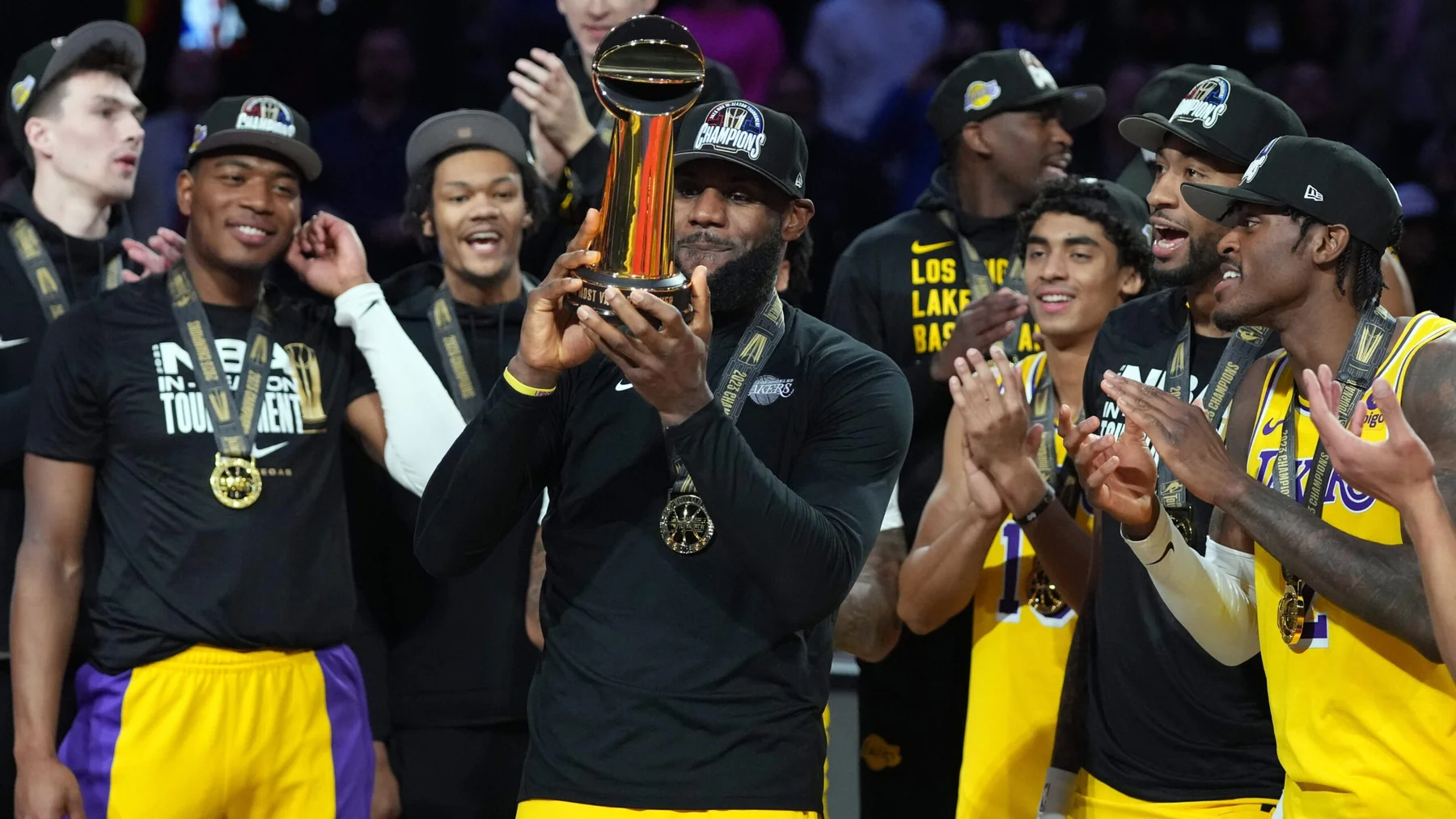
Davis owned the final, but the award was tournament MVP rather than championship-game MVP. Media voters evaluated Group Play and the knockout rounds, and James's full body of work was the strongest: 26.4 points, 8.0 rebounds and 7.0 assists per tournament game on 56.8% shooting. He finished the final with 24 points and 11 rebounds, then received the trophy for steering Los Angeles through all seven wins.
The distinction is essential for reading every winners list. The player with the loudest final box score does not automatically receive tournament MVP. James established tempo, created favorable matchups and gave the Lakers a dependable late-possession organizer across the event. Davis joined him on the All-Tournament Team, so the voting still recognized the center's broader impact. Their split honors capture the title accurately: Davis delivered the signature final, while James was judged the most valuable player across the inaugural competition.
2024 Milwaukee Bucks: defense and Giannis took over
Milwaukee's 2024 title carried a different meaning from the Lakers' inaugural win. The Bucks entered Cup play at 2-8, with their season already inviting questions about cohesion and age. They then went unbeaten in seven Cup games and defeated an Oklahoma City team that owned the NBA's top-rated defense entering the championship. The 97-81 final was the lowest-scoring title game in the competition's first three years and a reminder that a veteran team could use the Cup to sharpen its habits before spring.
The Bucks did not merely survive a poor Thunder shooting night. Their length crowded Shai Gilgeous-Alexander's driving lanes, their back line stayed active, and their offense created enough inside pressure for kick-out threes. Oklahoma City finished 5 of 32 beyond the arc and recorded season lows in points, field-goal percentage, made threes and assists. Milwaukee, by comparison, assisted 25 of its 34 field goals and made 17 threes. The resulting 51-15 scoring margin from deep supplied more than twice the final 16-point difference.
A 19-5 run broke open the final
Milwaukee led only 51-50 at halftime, so the trophy was still available to either team. The Bucks changed the game after the break by winning the third quarter 26-14. Giannis Antetokounmpo produced 12 points and 10 rebounds in that period, while Damian Lillard added eight points. The pair matched Oklahoma City's entire quarter by themselves, an efficient way to describe how completely Milwaukee's two-star structure took command.
The decisive surge became a 19-5 run spanning the second half, turning a five-point game into a 19-point Milwaukee lead early in the fourth. Oklahoma City could no longer load the paint without conceding a clean perimeter look. Brook Lopez, Gary Trent Jr. and AJ Green each made three triples, while Lillard made five. On defense, Milwaukee held the Thunder to 31 points across the entire second half and 33.7% shooting for the game. The run therefore came from linked possessions: a stop created a settled matchup or transition chance, the Bucks spaced around Giannis, and another make forced Oklahoma City to attack a set defense.
Giannis Antetokounmpo's unanimous MVP case
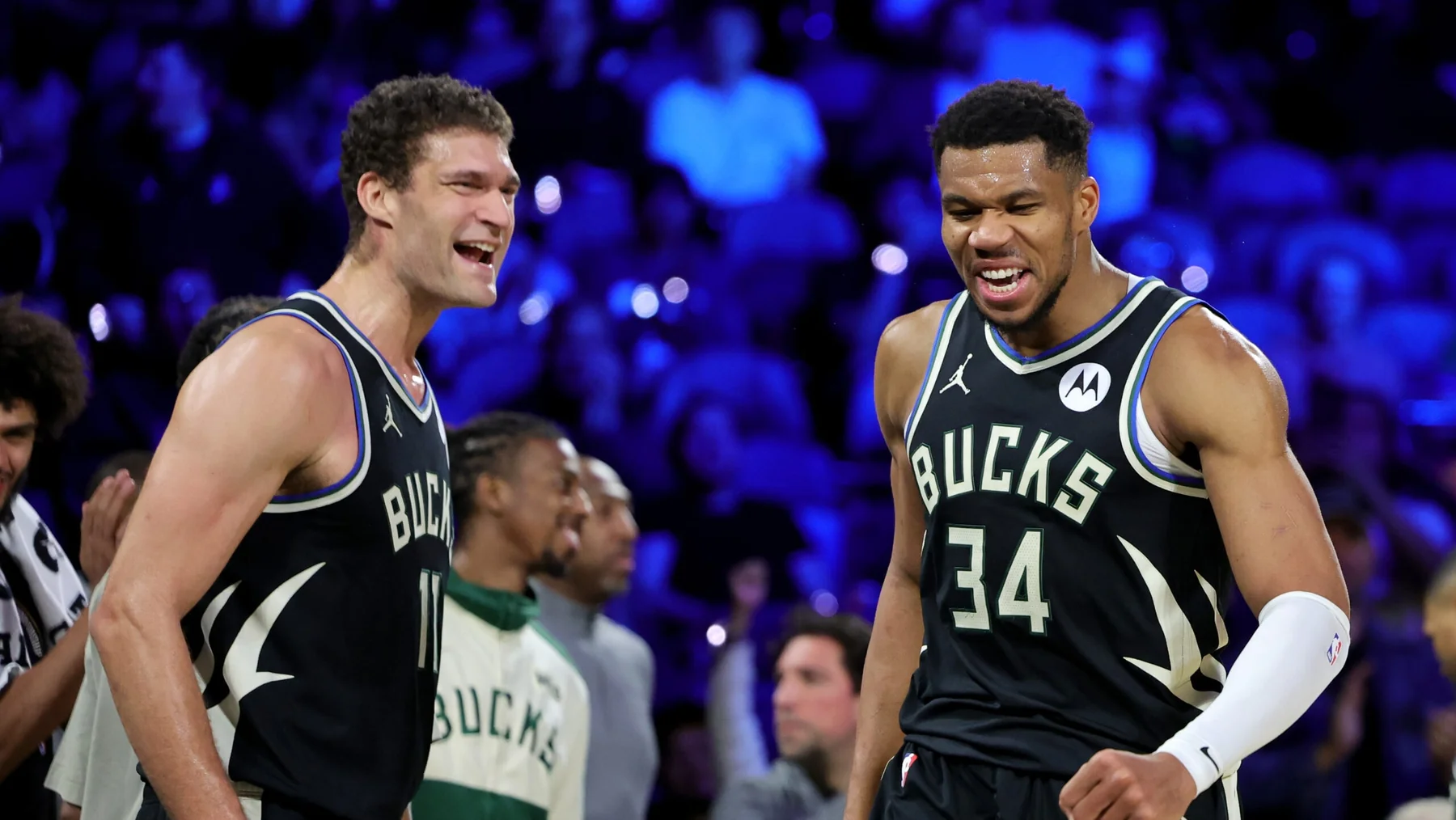
Antetokounmpo removed any ambiguity from the vote. His final line of 26 points, 19 rebounds, 10 assists, three blocks and two steals touched every part of the game, and the NBA's voting panel selected him unanimously. He could punish a smaller defender, screen for Lillard, find a shooter after the second defender committed, or erase a shot when Oklahoma City reached the rim.
The award also reflected his role across Milwaukee's 7-0 run. He scored 37 in a close quarterfinal against Orlando and combined with Lillard for 57 points in the semifinal win over Atlanta before producing the title-game triple-double. Unlike the 2023 split between Davis's spectacular final and James's tournament-wide MVP case, Milwaukee's best final performer and overall tournament driver were the same player. The honor added another category to Antetokounmpo's résumé after regular-season, Finals and All-Star Game MVP awards; more relevant to this competition, it documented how fully the Bucks' Cup identity depended on his two-way reach.
2025 New York Knicks: a fourth-quarter comeback
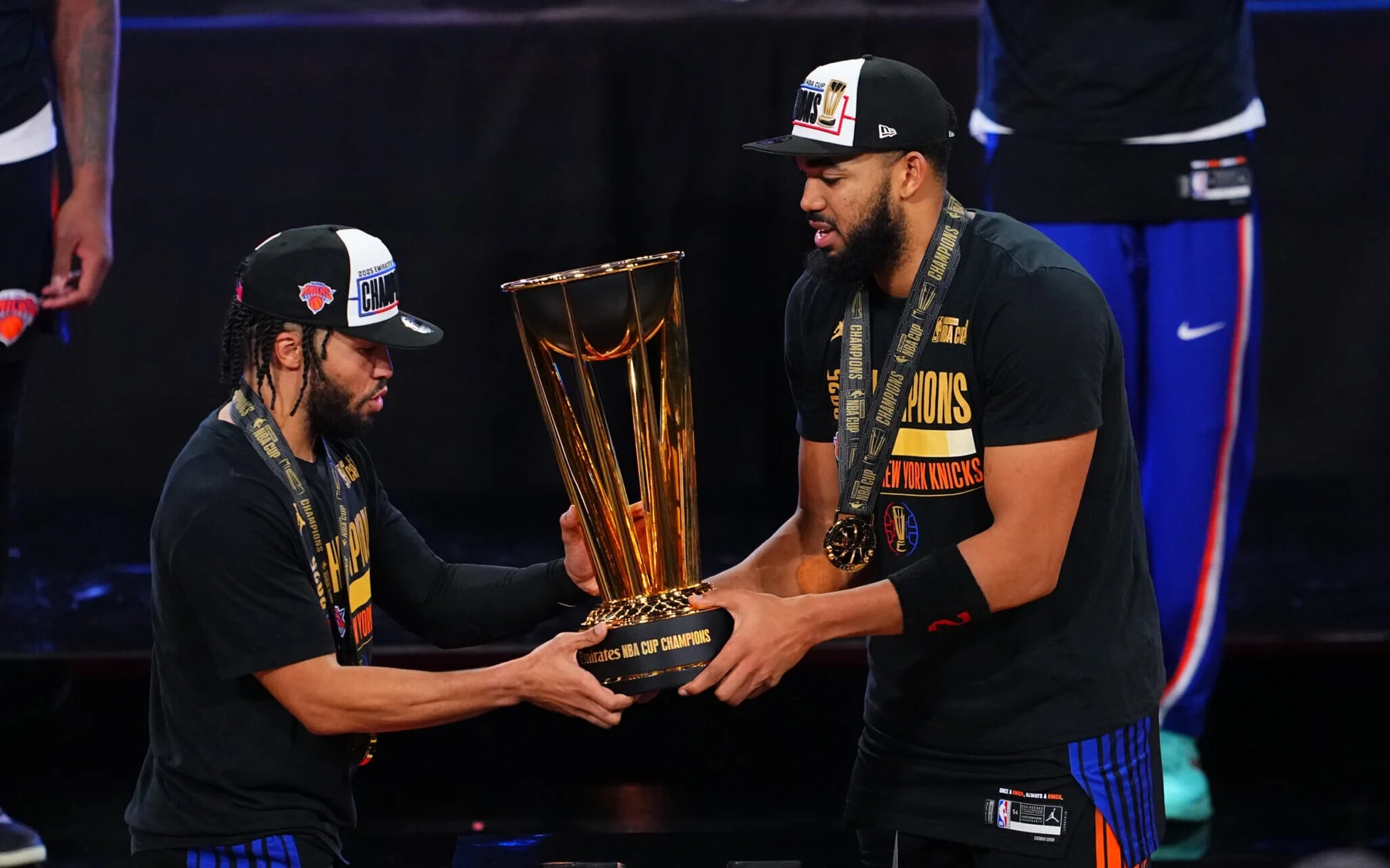
New York became the third NBA Cup champion by winning the title game from an uncomfortable position. San Antonio led by 11 with 2:07 left in the third quarter after Victor Wembanyama's scoring burst appeared to tilt the night toward the Spurs. The Knicks answered with a 43-21 closing stretch, including a 35-19 fourth quarter, and turned that deficit into a 124-113 win on December 16, 2025.
The comeback belonged to the full rotation. OG Anunoby scored 28 points with nine rebounds, Jalen Brunson finished with 25 points and eight assists, and reserves Mitchell Robinson, Tyler Kolek and Jordan Clarkson each solved a different problem. That spread distinguishes the 2025 final from Giannis Antetokounmpo's all-encompassing 2024 performance. New York's captain still organized the offense, but the title swung because role players supplied possessions, ball handling and shotmaking when the starters could not simply overpower San Antonio.
New York found its edge on the glass
The pivotal tactical adjustment was also the least glamorous: keep attacking missed shots. Robinson grabbed 15 rebounds in 18 minutes, including 10 on the offensive glass. One late sequence stretched to four New York offensive rebounds before San Antonio finally ended it. Even when those chances did not immediately produce points, they drained clock, prevented the Spurs from running after a rebound and forced Wembanyama to defend repeated actions around the rim.
New York totaled 23 offensive rebounds, five more than San Antonio, and collected 59 rebounds overall. The volume mattered because the Knicks did not need pristine shooting to rally; they could win the possession count. Once a 13-1 run carried New York from behind to a 100-95 lead, the Spurs faced both a scoreboard deficit and a physical rebounding problem. Josh Hart's timely three, Anunoby's two-way activity and Robinson's extra chances made the closing margin look comfortable even though San Antonio had controlled much of the first three quarters.
Jalen Brunson's MVP covered the full tournament
Brunson's championship line was strong without being the game's gaudiest. His MVP case came from six Cup appearances in which he scored 29, 33, 37, 35, 40 and 25 points. He missed New York's second group game with a sprained ankle, yet still led the 2025 tournament with 199 total points and averaged 33.2 points and 5.8 assists. He also shot 46% from three during the event, a hot six-game sample that amplified his ability to punish defenders for going under a screen.
The knockout rounds made the choice clearer. Brunson scored 35 against Toronto in the quarterfinal and 40 against Orlando in the semifinal, then created 17 additional final points through his eight assists. That meant his scoring and passing directly produced 42 of New York's 124 points. Anunoby was the final's leading Knicks scorer and Robinson may have created its most disruptive matchup, but Brunson carried the highest offensive load across the tournament.
That pattern reinforces the lesson from 2023: NBA Cup MVP is an event award. It rewards the player judged most valuable through Group Play and the knockout rounds, not an automatic honor for the title game's top scorer. Brunson's final showed leadership through delegation as much as volume. He let Kolek share creation duties, found open teammates when San Antonio sent help and remained the late-clock option whenever the possession broke down. For a team that had not lifted a major trophy since the 1973 NBA championship, his tournament-long stability gave the comeback a reliable center.
How each champion reached the final
Every champion had to win a group, or qualify as its conference's wild card, before navigating three single-elimination games. The compact format leaves little recovery time once the quarterfinals begin. One poor shooting night, an early foul problem or a short defensive lapse can end the run, which is why the route adds useful context beyond the final score.
| Champion | Group Play | Quarterfinal | Semifinal | Full Cup record |
|---|---|---|---|---|
| 2023 Lakers | 4-0, West No. 1 | 106-103 vs. Suns | 133-89 vs. Pelicans | 7-0 |
| 2024 Bucks | 4-0, East No. 1 | 114-109 vs. Magic | 110-102 vs. Hawks | 7-0 |
| 2025 Knicks | 3-1, East Group C winner | 117-101 at Raptors | 132-120 vs. Magic | 6-1 |
Three title runs, three different routes
The Lakers had the most dramatic change in knockout tone. They escaped Phoenix by three in the quarterfinal, then overwhelmed New Orleans by 44 before beating Indiana by 14. Their route moved from late-game execution to a semifinal avalanche and finally a paint-based title plan. That range helps explain why the inaugural winner cannot be reduced to a single favorable matchup.
Milwaukee's margins were steadier until the final. The Bucks held off Orlando by five and Atlanta by eight, then produced their best defensive result against Oklahoma City. Their 7-0 tournament coincided with a broader correction after the 2-8 season start, making the Cup run evidence of improved organization rather than seven isolated wins. Giannis and Lillard handled the late offense in the tighter games before the supporting shooters expanded the floor in the championship.
New York is the only champion so far that lost during Group Play. The Knicks still won East Group C at 3-1, beat Toronto on the road by 16, scored 132 against Orlando in Las Vegas and then came back against San Antonio. Their 6-1 record is not a flaw in the title: the format does not require perfection, only qualification followed by three knockout victories. It instead shows a second route to the trophy, one in which a team can learn from an early loss and peak during the elimination stage.
What the first three winners have in common and what history cannot prove
The clearest shared trait is not age, pace or shot profile. It is top-end creation supported by a second player good enough to shape a knockout game. Every champion placed two teammates on the All-Tournament Team: LeBron James and Anthony Davis for Los Angeles, Giannis Antetokounmpo and Damian Lillard for Milwaukee, then Jalen Brunson and Karl-Anthony Towns for New York. A single-elimination bracket rewards the team that can still generate a credible option after the defense takes away its first action.
All three champions also changed the way they won as the matchup demanded. The Lakers shifted from a close quarterfinal to a transition-heavy semifinal and a paint-dominant final. The Bucks leaned on Antetokounmpo and Lillard in tight knockout games before a defense-and-three-point formula overwhelmed Oklahoma City. The Knicks won a road quarterfinal, shot 61% in the semifinal and then survived a far messier final by owning the offensive glass. Tactical flexibility is a more useful common thread than searching for one universal Cup style.
The postseason evidence, however, breaks any simple claim that a December trophy predicts a June championship. The 2023-24 Lakers entered the playoffs through the Play-In and lost 4-1 to Denver in the first round. The 2024-25 Bucks also went out 4-1 in the first round, against Indiana. New York then produced the opposite outcome, becoming the first team to win the NBA Cup and the NBA championship in the same season in 2025-26. Those three results include two early exits and one historic double.
That spread is exactly why the sample should remain descriptive. The Cup can reveal how a roster handles urgency, condensed preparation and win-or-go-home pressure. It can also accelerate confidence, as Milwaukee's run after a 2-8 start demonstrated. It cannot lock in health, trade-deadline changes, playoff seeding or the matchups a team will see four to six months later. Fans can treat an NBA Cup title as a legitimate championship in its own competition without treating it as a forecast model for the NBA playoffs.
How NBA Cup titles, MVPs and records are counted
The winners table is simple only after two bookkeeping issues are settled. First, the 2023 In-Season Tournament and the later Emirates NBA Cup belong to the same competition history. Second, the championship game is a real Cup contest with its own result and awards, but it is deliberately kept outside the NBA regular-season standings and statistical record.
The name changed after the inaugural tournament
The NBA launched the event in 2023 as the NBA In-Season Tournament. The winning team still received the NBA Cup, which is why the Lakers are correctly described as the first NBA Cup champions even though contemporary headlines used the original tournament name. In February 2024, Emirates became the title partner and the league renamed the event the Emirates NBA Cup. The format remained an annual 30-team competition rather than beginning a second historical series.
Searches for “In-Season Tournament winners” and “NBA Cup winners” should therefore return the same lineage: Lakers in 2023, Bucks in 2024 and Knicks in 2025. The sponsor belongs in the current official event name, but the shorter “NBA Cup” is the stable historical label. The same principle applies to individual honors. NBA history pages may use “All-Tournament Team” or “All-NBA Cup team”; neither should be confused with the season-long All-NBA teams chosen after the regular season.
The championship sits outside regular-season statistics
Group Play, quarterfinal and semifinal games count toward the 82-game regular season. Their wins, losses and player statistics flow into the usual standings and season totals. The championship is the exception. It does not change either finalist's regular-season record, and individual or team production in that game is excluded from regular-season statistics.
All Group Play and knockout games, including the championship. This is why the 2023 Lakers and 2024 Bucks are described as 7-0 Cup champions.
Group Play, quarterfinals and semifinals. The championship result and its statistics are excluded.
The distinction prevents familiar apparent discrepancies. Davis's 41 points and 20 rebounds against Indiana remain the defining numbers of the 2023 Cup final, but they did not increase his 2023-24 regular-season totals. Antetokounmpo's 26-point, 19-rebound, 10-assist line is the first championship-game triple-double in Cup history, but it is not a regular-season triple-double. A team's Cup record may also show one more game than the Cup-related wins visible in its regular-season record.
MVP voting belongs to the tournament ledger too. The media panel evaluates performance across Group Play and the Knockout Rounds, so the award is broader than a one-game final MVP. That is why James could win in 2023 after Davis produced the title game's largest performance, while Antetokounmpo in 2024 and Brunson in 2025 paired sustained tournament play with decisive championship contributions. For the rules behind qualification, tiebreakers and the knockout field, see the NBA Cup rules and prize-money guide.
Sign in with Google to join the discussion.